



Employee turnover isn’t just frustrating; it’s expensive. Research from the Society for Human Resource Management (SHRM) estimates that replacing an employee can cost six to nine months of that employee’s salary. For a $60,000 role, that’s up to $45,000 per replacement.
Beyond the financial impact, turnover disrupts team dynamics, delays projects, and puts additional pressure on remaining employees. HR professionals often invest significant time in recruiting and onboarding talented individuals, only to see them leave within months. The cycle repeats, leaving organizations wondering what went wrong.
Employee turnover rarely occurs without warning. In many cases, there are identifiable patterns: misaligned expectations during hiring, insufficient career development opportunities, ineffective leadership, or burnout from heavy workloads.
Organizations can reduce employee turnover by identifying issues earlier and addressing them with the right tools and strategies.
In this article, we’ll explore the true cost of employee turnover, examine why employees leave, and discuss how modern employee retention tools like assessments can help organizations prevent avoidable turnover.
The True Cost of Employee Turnover
The cost of employee turnover extends far beyond posting job listings or paying recruiter fees.
Every departure triggers a chain reaction across the organization. HR teams must restart the hiring process, managers must devote time to interviewing candidates, and new hires require training before they can fully contribute. During this transition period, productivity often declines as remaining team members cover the workload.
When organizations look more closely, they begin to see that turnover isn’t just a one-time expense, but an ongoing drain on time, resources, and momentum.
Some of these costs are easy to measure, while others are harder to quantify but just as impactful.
Hard Costs
The most visible expenses are the direct, out-of-pocket costs associated with replacing an employee. These typically range from recruiting efforts, internal time spent sourcing and evaluating candidates, all the way through to onboarding and training programs::
- Recruiting and job advertising
- HR and recruiter time spent sourcing candidates
- Interview coordination
- Background checks
- Onboarding programs
- Training and ramp-up time
Soft Costs
In addition to the hard costs of replacing an employee, the hidden costs of employee turnover can be even more damaging.
When an experienced employee leaves, organizations lose potentially years of knowledge and relationship-building, including:
- Institutional knowledge
- Customer relationships
- Team productivity
- Team morale
Remaining employees often absorb the additional work, increasing the risk of burnout and further turnover.
A Simple Cost-of-Turnover Formula
HR teams can estimate turnover costs with this basic calculation:
Cost of turnover = (Recruiting cost + onboarding cost + training cost + productivity loss) per employee
For example:
- Recruiting: $6,000
- Onboarding: $2,500
- Training: $4,000
- Productivity loss: $12,000
Total turnover cost: $24,500 per employee
Understanding this cost helps organizations justify investing in employee turnover solutions like better hiring processes, leadership development, and employee assessments.
Why Employees Really Leave (The Root Causes)
To effectively reduce employee turnover, organizations must understand why employees leave in the first place.
The key difference between reactive and high-performing organizations is this: the best teams don’t just identify these issues; they measure them early and act on them. That’s where assessments begin to play a critical role.
Several common factors consistently appear across industries.
Poor Job Fit
One of the most common (and preventable) causes of turnover is poor job fit. When hiring decisions focus only on technical skills, they often miss whether a candidate will actually thrive in the role or environment.
For example, imagine hiring a highly skilled analyst who prefers independent, deep-focus work into a fast-paced, highly collaborative team. On paper, they’re a perfect match. In practice, they quickly become frustrated by the constant meetings and interruptions.
When employees realize the role doesn’t align with their expectations or strengths, disengagement quickly follows. This is where pre-hire assessments make a measurable difference.
Assessments can measure:
- Work style preferences
- Behavioral traits
- Motivational drivers
- Communication styles
Instead of guessing, hiring teams can see whether a candidate prefers structured vs. flexible environments, individual vs. team-based work, or fast vs. steady workflows.
That insight helps companies hire for long-term success, not just immediate capability.
Weak Management
Studies consistently show that manager quality strongly influences employee retention.
Poor communication, unclear expectations, and lack of support can push employees to seek opportunities elsewhere.
Consider a team where a manager unintentionally creates friction by giving minimal feedback and unclear direction. Employees may feel unsupported, even if the manager believes they’re empowering autonomy.
Leadership assessments can uncover these gaps. For instance, a manager might score high in strategic thinking but lower in communication clarity or coaching ability. With that data, HR teams can provide targeted development, such as training on feedback delivery or one-on-one communication.
In another case, 360-degree assessments can reveal perception gaps between how managers see themselves and how their teams experience them. That kind of insight is often the turning point for improving retention on struggling teams.
Lack of Career Growth
When employees can’t see a future within the organization, they often start looking elsewhere. This can happen even if they’re otherwise satisfied in their roles.
The challenge is that career growth isn’t always a compensation issue. More often, it’s a visibility issue. Employees don’t know what skills they need to develop or what opportunities are available to them.
Assessments help make growth tangible. For example, a skills assessment might show that an employee is strong in execution but needs development in strategic thinking to move into a leadership role. Instead of vague advice, managers can provide a clear development plan tied to measurable outcomes.
Similarly, potential assessments can identify high-potential employees early, allowing organizations to invest in leadership pipelines before turnover becomes a risk.
Feeling Undervalued
Employees rarely leave simply because they aren’t told “good job!” However, over time, a lack of recognition and feedback can create a sense that their work doesn’t matter.
This issue is often invisible until it’s too late. High performers, in particular, may disengage quietly before leaving.
Engagement assessments provide a way to uncover this early. For example, if survey data shows a consistent dip in responses to statements like “I feel recognized for my contributions,” HR teams can pinpoint where the problem exists, and whether it’s isolated to a specific department or manager.
From there, organizations can take targeted action, such as implementing structured recognition programs, or coaching managers to provide more consistent feedback.
Culture Misalignment
Culture fit reflects whether an employee’s values, communication style, and expectations align with how the organization operates day to day.
For instance, an employee who values transparency and open dialogue may struggle in a culture where decisions are made behind closed doors. Over time, that disconnect can lead to frustration and disengagement.
Team-based assessments can highlight these mismatches. By mapping communication styles and collaboration preferences across a team, organizations can identify where friction is likely to occur.
In some cases, this leads to simple but effective adjustments, like setting clearer expectations around communication norms or decision-making processes. In others, it informs hiring decisions to ensure stronger alignment from the start.
Burnout and Workload Imbalance
Burnout is one of the fastest-growing drivers of turnover, particularly in high-demand or understaffed environments. What makes it especially challenging is that it often builds gradually.
An employee may start by taking on extra responsibilities, then slowly become overwhelmed as workloads increase and priorities remain unclear. By the time they disengage, the damage is already done.
Regular engagement surveys and pulse assessments can act as an early warning system. For example, if employees begin reporting declines in work-life balance or increases in stress levels, HR teams can intervene before burnout leads to resignations.
In a real-world scenario, a company can use quarterly pulse surveys to identify spikes in workload concerns within a specific department. Then, by redistributing responsibilities and clarifying priorities, they can stabilize the team and prevent further turnover.
By connecting each of these root causes to measurable data, assessments transform retention from a guessing game into a strategic advantage. Instead of reacting to turnover after it happens, organizations can anticipate risks and address them before employees decide to leave.
3 Types of Employee Turnover
Before implementing retention initiatives, it is important to understand the types of employee turnover occurring within an organization. Not all turnover has the same causes or requires the same solutions.
1. Voluntary vs. Involuntary Turnover
Voluntary turnover occurs when employees choose to leave on their own.
Examples include:
- Accepting another job
- Relocation
- Career change
Involuntary turnover happens when the employer ends the relationship due to:
- Performance issues
- Organizational restructuring
- Policy violations
2. Regrettable vs. Non-Regrettable Turnover
Not all turnover carries the same weight, and treating it as if it does can lead organizations to invest time and resources in the wrong areas.
Regrettable turnover occurs when high-performing employees leave, causing organizations to experience a significant loss of expertise and leadership potential. This type of departure should be a primary focus of retention strategies.
These are the individuals who often hold critical knowledge, consistently deliver strong results, or show leadership potential. When they exit, the impact goes far beyond simply filling an open role. Teams may lose momentum, customer relationships can suffer, and remaining employees may begin to question their own long-term future with the company.
This is why understanding regrettable turnover is so important. It helps HR teams focus their retention efforts where they matter most: protecting top talent and strengthening the conditions that keep them engaged.
Non-regrettable turnover typically involves employees who were not a strong fit for the organization. While still disruptive in the short term, this type of turnover can create space to bring in individuals who are better aligned with team needs and company goals.
The key is not to eliminate turnover entirely, but to manage it strategically. Organizations that fail to distinguish between these two types often misinterpret their data. For example, a company might celebrate a declining turnover rate, without realizing they are retaining underperformers and losing high achievers.
This is where employee retention tools and assessments become especially valuable. By combining performance data, engagement insights, and behavioral assessments, organizations can identify which employees are most critical to retain and their risk of leaving.
3. Early Turnover (First 90 Days)
Early turnover, particularly within the first 90 days, is one of the most revealing metrics an organization can track. It’s also one of the most overlooked.
When employees leave shortly after being hired, it almost always points to breakdowns earlier in the employee lifecycle. It may signal poor job fit, where the role doesn’t align with the employee’s strengths or expectations. In other cases, it reflects misalignment during the hiring process, where the reality of the job differs from what was communicated. Weak or inconsistent onboarding can also leave new hires feeling unsupported and disconnected from the start.
What makes early turnover especially important is its ripple effect. Beyond the immediate cost of employee turnover, frequent early exits can damage employer brand, lower team morale, and create skepticism among existing employees about hiring decisions. It can also overwhelm managers who are repeatedly onboarding new team members instead of building long-term team stability.
More importantly, early turnover is one of the clearest indicators that something foundational needs to change. Unlike long-term attrition, which may stem from evolving career goals or external opportunities, early turnover is often preventable with the right adjustments.
By analyzing early turnover trends, organizations can refine job descriptions, improve interview processes, and strengthen onboarding programs.
Assessments play a key role here by ensuring candidates are evaluated not just for skills, but for alignment with the role, team, and work environment.
Industry-Specific Turnover Benchmarks
Turnover rates vary significantly across industries, which means HR leaders must evaluate their numbers within the proper context.
According to recent data from the U.S. Bureau of Labor Statistics, the national average employee turnover rate across all industries is 3.3%. However, this rate varies by industry and industry subcategories, especially when you frame it in the more targeted monthly separation metric
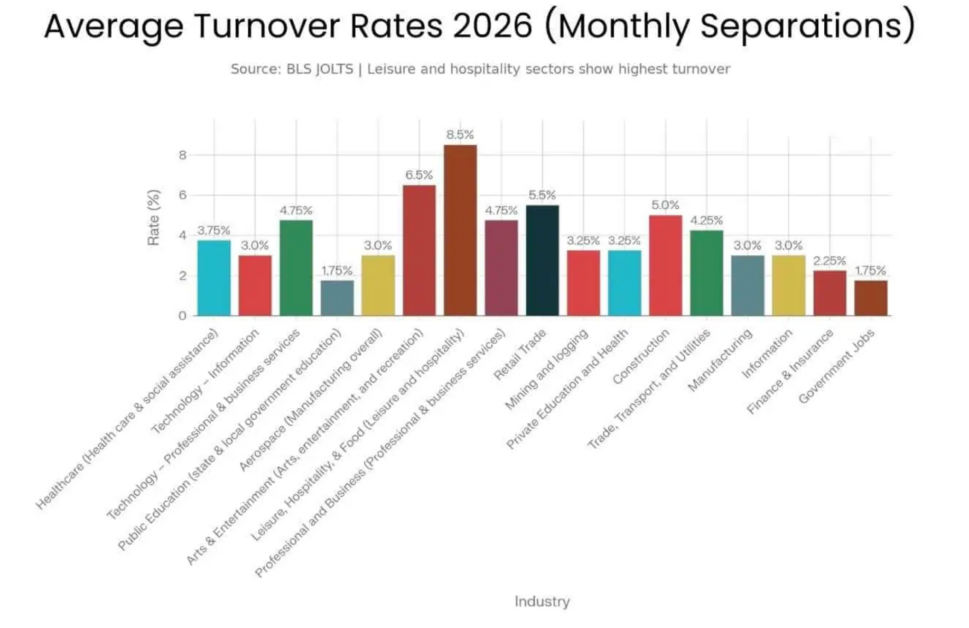
Understanding industry benchmarks helps organizations evaluate whether their turnover rate is unusually high, or relatively typical. For example, retail and hospitality organizations often report higher annual turnover rates, while technology companies may see rates significantly lower.
If rates significantly exceed industry norms, it may indicate underlying issues related to management practices, workplace culture, or hiring processes.
The Manager’s Role in Retention
Few factors influence employee retention more than the quality of management. There’s a well-known phrase in HR: people don’t leave companies; they leave managers.
While the statement may oversimplify complex workplace dynamics, it reflects an important truth: the relationship between employees and their direct supervisors has a profound impact on engagement.
Managers shape the day-to-day employee experience. They set expectations, provide feedback, and influence how work is prioritized and distributed. When managers communicate clearly and take an active interest in employee development, they create an environment where people feel supported and motivated to stay.
But not all managers naturally have these skills, and without clear data, it can be difficult for HR teams to pinpoint where support is needed.
This is where assessments become especially valuable.
HR professionals can use leadership and 360-degree assessments to evaluate how managers are performing across key areas such as communication, coaching ability, emotional intelligence, and decision-making. For example, a manager might believe they are providing sufficient guidance, while their team’s assessment results reveal a lack of clarity or inconsistent feedback.
These insights give HR teams something concrete to act on. Instead of offering generic leadership training, organizations can deliver targeted coaching based on specific gaps. A manager who struggles with feedback can be trained on structured one-on-one conversations, while another who scores lower in team support might benefit from workload management strategies.
Over time, this kind of targeted development leads to measurable improvements in how managers lead, and that directly impacts retention. Employees who feel heard, supported, and guided are far more likely to stay and grow within the organization.
In this way, assessments don’t just evaluate managers; they become a practical tool for strengthening leadership effectiveness and implementing long-term employee turnover solutions.
Remote and Hybrid Work Considerations
As remote and hybrid work models become more common, organizations must adapt their retention strategies to support distributed teams.
Remote employees may face challenges that traditional office environments rarely encounter. Feelings of isolation, communication gaps, and limited visibility into advancement opportunities can gradually reduce engagement.
Managers play a particularly important role in remote environments. Frequent check-ins, clear expectations, and intentional recognition of accomplishments help ensure employees feel connected to their teams.
Assessments can also help distributed teams understand differences in work styles and communication preferences. By identifying these patterns, organizations can foster stronger collaboration even when employees are located across multiple time zones.
How Assessments Improve Employee Retention
Modern employee retention tools increasingly rely on data-driven insights. Among these tools, candidate assessments stand out as one of the most versatile and effective solutions.
Why? These assessments can support employee retention across multiple stages of the employee lifecycle.
Assessments Improve Hiring Accuracy
During hiring, assessments help organizations evaluate whether candidates possess the behavioral traits and motivations required for success in a particular role.
Examples include:
- Problem-solving ability
- Behavioral traits
- Motivation drivers
- Communication style
This improves job fit and reduces early turnover.
Behavioral Assessments Improve Manager Relationships
Once employees join the organization, behavioral assessments can improve communication between managers and team members.
By understanding individual work styles, managers can tailor their leadership approaches to better support each employee.
Team Assessments Improve Collaboration
Team assessments provide another valuable perspective. They highlight communication patterns and collaboration dynamics, allowing organizations to address potential conflicts before they escalate.
These insights help teams collaborate more effectively.
Engagement Assessments Identify Burnout Risk
Regular engagement assessments can reveal early warning signs of disengagement. That way, HR teams can then intervene before employees decide to leave.
Organizations can also use assessments alongside performance and feedback tools to support continuous development.
Platforms like Agolix enable organizations to design and deploy customized assessments tailored to their unique needs. Whether evaluating leadership effectiveness, employee engagement, or team dynamics, these tools provide actionable insights that support smarter workforce decisions.
7 Strategies to Reduce Employee Turnover With Assessments
Organizations that successfully reduce employee turnover rarely rely on a single tactic. Instead, they use data, like that from assessments, to guide smarter decisions across hiring, development, and engagement.
When used consistently, assessments transform retention from a reactive process into a proactive strategy.
1. Hire for Fit, Not Just Skills
The hiring process represents one of the most powerful opportunities to prevent turnover. When organizations focus on identifying candidates who align with both the job requirements and the company culture, they significantly increase the likelihood of long-term success.
Pre-hire assessments help organizations evaluate how candidates are likely to behave in real work environments. For example, a role that requires constant collaboration and fast decision-making may not be a good fit for someone who prefers independent, structured work.
By using assessments to measure personality traits, motivational drivers, and communication preferences, HR teams can make more informed hiring decisions. This works to significantly reduce early turnover and improve long-term success.
2. Strengthen the Onboarding Experience
Onboarding isn’t just about training; it’s about alignment. Assessments can provide a head start with this.
When organizations use assessment data from the hiring process, they can tailor onboarding experiences to each employee’s needs. For instance, a new hire who prefers hands-on learning can be given more interactive training, while someone who values structure may benefit from detailed onboarding plans and documentation.
In addition, early-stage pulse assessments during the first 30–90 days can help HR teams quickly identify whether new hires feel supported, clear on expectations, and connected to their team. This allows for timely intervention before small issues turn into early exits.
3. Use Leadership Assessments to Strengthen Manager Development
Manager quality has a direct impact on retention, but without clear data it’s difficult to know where improvements are needed.
Leadership and 360-degree assessments provide visibility into how managers are actually performing. For example, a manager may rate themselves highly in communication, while team feedback reveals gaps in clarity and consistency.
These insights allow HR teams to deliver targeted coaching instead of broad, one-size-fits-all training. Over time, improving specific leadership behaviors, like feedback delivery or team support, can significantly enhance employee experience and reduce turnover at the team level.
4. Create Clear Career Paths Using Assessment Data
Career growth is one of the strongest drivers of retention, but many organizations struggle to make development feel tangible.
Assessments help bridge that gap by identifying skill levels, strengths, and areas for growth. For example, an employee interested in leadership may discover through an assessment that they need to develop strategic thinking or communication skills.
With this data, managers can create personalized development plans tied to measurable progress. Employees gain a clearer understanding of what’s required to advance, which increases engagement and reduces the likelihood of them seeking growth opportunities elsewhere.
5. Build a Recognition and Feedback Culture
Recognition and feedback are essential, but they’re often inconsistent across teams.
Engagement assessments help HR teams understand how employees actually feel about recognition in their organization. For instance, survey results may reveal that employees in one department feel undervalued, while another team reports strong support and acknowledgment.
Armed with this insight, organizations can take targeted action, such as coaching specific managers or implementing structured recognition programs. Rather than guessing, HR teams can focus their efforts where they’ll have the greatest impact on retention.
6. Replace Guesswork With Stay Interviews and Ongoing Assessments
Stay interviews are a valuable tool, but when combined with assessment data, they become far more powerful.
Instead of relying solely on conversations, HR teams can use engagement and sentiment assessments to guide stay interview discussions. For example, if assessment results indicate declining satisfaction around workload or career growth, managers can address those topics directly.
This combination of qualitative and quantitative data leads to more meaningful conversations, and more actionable outcomes that help retain employees before they consider leaving.
7. Use Assessment Data to Spot Flight Risks Earlier
One of the biggest advantages of modern employee turnover solutions is the ability to detect risk before it becomes reality.
By analyzing trends in engagement assessments, performance data, and behavioral insights, organizations can identify patterns that signal potential turnover. For example, a drop in engagement scores, combined with increased workload concerns, may indicate burnout risk within a specific team.
With this information, HR teams can take proactive steps like adjusting workloads, improving manager support, or offering development opportunities before employees disengage or resign.
How to Measure Your Employee Retention Efforts
Improving retention requires consistent measurement and analysis. Organizations must track key metrics to understand whether their strategies are producing meaningful results.
These key metrics include:
- Turnover rate
- Retention rate
- Time-to-productivity
- Employee engagement scores
How to Calculate Turnover Rate
Use this formula:
Turnover Rate = (Number of employees who left during a period / Average number of employees) x 100
For example, if 12 employees leave during a year and the average workforce is 120, the turnover rate is 10%.
Assessment data can also serve as a leading indicator of potential turnover risks.
When engagement scores decline or burnout indicators rise, HR teams can act early.
Retention rate offers a complementary perspective by measuring how many employees remain over time. When analyzed alongside engagement scores and productivity metrics, these indicators provide a comprehensive picture of workforce stability.
Assessment data can also serve as an early warning system. When engagement levels decline or workload concerns increase, HR teams can intervene before employees begin searching for new opportunities.
A Turnover Prevention Checklist
Even with sophisticated analytics tools, many HR leaders benefit from a simple framework to evaluate their retention efforts.
The difference is that today, the most effective frameworks are powered by assessment data, not assumptions.
This checklist is designed to help HR teams connect everyday retention practices with the insights provided by modern employee retention tools.
- Use pre-hire assessments to evaluate job fit, including behavioral traits, work styles, and motivations
- Provide structured onboarding for new hires, leveraging onboarding assessments or early pulse surveys within the first 90 days
- Implement leadership and 360-degree assessments to identify manager strengths and development areas
- Conduct regular engagement assessments to track employee sentiment and uncover hidden retention risks
- Use team assessments to improve collaboration and communication
- Apply skills and development assessments to create clear, personalized career growth paths
- Use engagement data to ensure recognition efforts are meaningful and aligned with employee expectations
- Combine stay interviews with assessment insights to guide more focused, data-informed conversations
- Monitor workload and burnout risk through ongoing pulse surveys and engagement metrics
- Integrate assessment data into broader employee turnover solutions to identify trends and predict flight risks
This checklist can help organizations identify gaps in their current approach. When these practices work together, they create an environment where employees feel valued, supported, and motivated to stay.
Improve Retention with Assessments
Employee turnover is costly, but it’s rarely unavoidable.
Organizations that understand the types of employee turnover, identify root causes, and implement proactive strategies can significantly improve retention.
Assessments play a powerful role in this process.
By helping companies hire for fit, strengthen management practices, improve team collaboration, and detect disengagement early, assessments provide actionable insights that support long-term employee success.
Instead of reacting to turnover after it happens, HR leaders can take a data-driven approach to retention.
If you’re ready to start building customized assessments for hiring, engagement, and leadership development, Agolix makes it easy to design and deploy powerful evaluation tools. Get started here today!