


Personality assessments are everywhere in today’s workplace. In fact, research estimates that up to 80% of Fortune 500 companies use some form of personality testing in their hiring or employee development processes.
Despite their widespread use, skepticism of their effectiveness still exists. Do personality assessments actually work? What if they are just a trendy new HR tool?
The truth is that modern employee personality assessments are built on decades of psychological research. When designed and used properly, they can reveal consistent patterns in how people think, communicate, make decisions, and approach work.
In this article, we’ll explore the science behind personality assessments, including the psychological frameworks that support them and the research that explains why they are effective in workplace settings.
What Is a Personality Assessment and What Is It Actually Measuring?
A personality assessment is a structured evaluation designed to measure consistent patterns in how individuals think, feel, and behave. These patterns, often called personality traits, tend to remain relatively stable over time.
In the workplace, personality assessments are used to better understand how employees may approach tasks, interact with colleagues, respond to stress, or make decisions.
Personality vs. Behavior vs. Skills
One reason personality tests for employment can feel confusing is that they measure something different from traditional hiring tools.
- Skills: What someone can do (technical abilities, certifications, experience)
- Behavior: How someone acts in a specific situation
- Personality: The underlying tendencies that influence behavior
For example, let’s look at a candidate who has strong analytical skills. Their personality traits might determine whether they prefer independent work, collaborative environments, or leadership roles.
Personality assessments capture patterns of behavior across many situations, which makes them useful for predicting how someone might operate in a workplace environment.
According to the American Psychological Association, personality traits represent enduring patterns that influence how individuals respond to different situations and environments. Because these patterns are relatively consistent, they provide valuable insight when evaluating job fit, team dynamics, and leadership potential.
What the Research Actually Says About Personality Assessments
For skeptics, the key question remains: Do personality assessments actually predict job performance?
Research suggests they do. An article published by the National Library of Medicine found that certain personality traits, particularly conscientiousness, are strong predictors of job performance across industries.
Why does conscientiousness matter so much?
At its core, this trait reflects a person’s tendency to be organized, dependable, and goal-oriented. Employees who score higher in conscientiousness are more likely to follow through on commitments, maintain consistent work habits, and approach tasks with discipline.
In practical terms, these individuals often demonstrate qualities that organizations value in almost any role, such as:
- Reliability and dependability
- Strong organizational habits
- Persistence in completing tasks
- Consistent performance over time
Because these patterns show up repeatedly across different job functions, conscientiousness has become one of the most studied personality predictors in organizational psychology.
Relating Personality + Cognitive Ability
While personality traits provide valuable insights, research shows that their predictive power becomes even stronger when combined with cognitive ability assessments.
Cognitive assessments measure how individuals process information, solve problems, and learn new concepts. When organizations evaluate both how people think and how they tend to behave, they gain a more complete picture of a candidate’s potential.
For example:
- Cognitive ability may predict how quickly someone can learn a new system or solve complex problems.
- Personality traits help predict how consistently they will apply those abilities in real-world work environments.
Together, these insights allow employers to evaluate both capability and behavioral tendencies, which are equally important when forecasting job success.
Using Personality Assessments to Reduce Turnover
Another area where personality assessments demonstrate measurable value is employee retention.
Turnover is rarely caused by a lack of skills alone. More often, employees leave when there is a conflict between their natural work style and the demands of the role or organization.
For example, a highly independent employee may struggle in a role that requires constant collaboration. Or, a highly structured individual may feel overwhelmed in a fast-moving, ambiguous environment like a startup.
Personality assessments help organizations identify these potential mismatches before they lead to disengagement or burnout.
When employees are placed in roles that align with their personality traits and preferences, they are more likely to:
- Feel satisfied with their work
- Build stronger relationships with colleagues
- Adapt more comfortably to team dynamics
- Remain with the organization longer
Over time, this alignment can lead to higher engagement and lower turnover, both of which contribute to stronger organizational performance.
Understanding Reliability and Validity
Of course, not every personality test on the market is scientifically-backed. While Big Five-based assessments are widely recognized for their strong scientific backing and Hogan Assessments are also research-driven, tools like DISC are more behavioral than predictive. That doesn’t mean they aren’t highly effective for understanding communication styles and team dynamics. It is, however, why HR professionals evaluating an employee personality assessment should pay close attention to two key concepts: reliability and validity.
Reliability refers to consistency. A reliable assessment produces similar results when the same individual takes the test under similar conditions at different points in time. If someone’s personality profile changes dramatically from one attempt to the next, the assessment may not be measuring stable traits.
Validity, on the other hand, refers to accuracy. A valid assessment actually measures the psychological traits it claims to measure and demonstrates a meaningful relationship to workplace outcomes such as job performance, leadership effectiveness, or team collaboration.
High-quality personality assessments typically provide technical documentation and validation studies demonstrating both reliability and validity. For organizations using personality tests for employment, reviewing this evidence is an important step in ensuring that assessment results are both scientifically grounded and ethically applied.
The Psychological Frameworks Behind Personality Assessments
Modern personality testing isn’t guesswork. It is grounded in trait theory, one of the most widely supported areas of personality psychology.
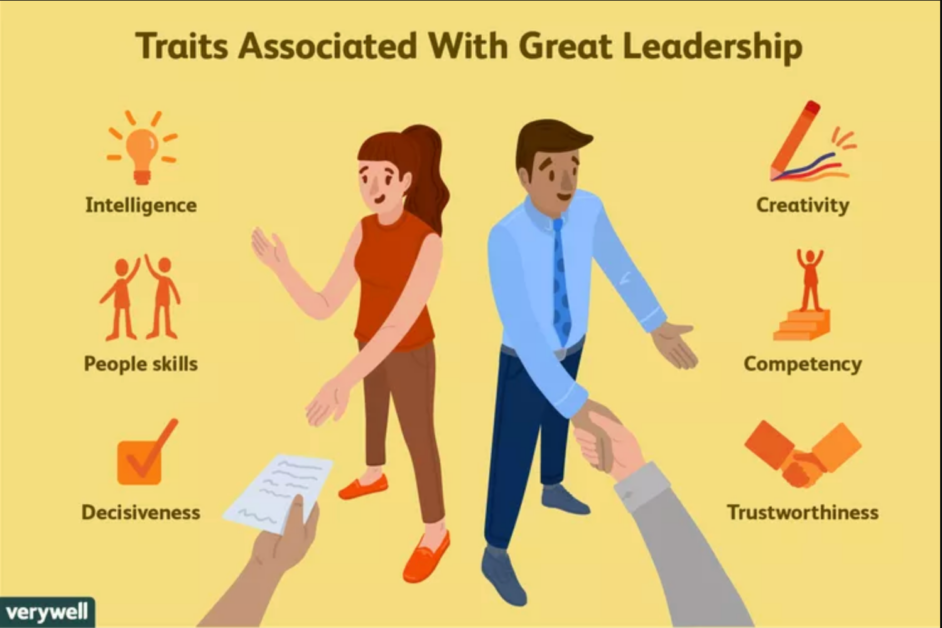
Trait theory proposes that personality is made up of stable, measurable dimensions that influence behavior across different contexts.
The Big Five Personality Model
When psychologists talk about the science of personality, one framework appears again and again: the Big Five personality model, often called the OCEAN model.
Unlike earlier personality theories that relied on intuition or observation alone, the Big Five emerged from decades of statistical research and factor analysis. Researchers analyzed thousands of personality descriptors and discovered that most personality traits cluster into five broad, measurable dimensions.
- Openness- curiosity, creativity, openness to new ideas
- Conscientiousness- organization, discipline, reliability
- Extraversion- sociability, energy, assertiveness
- Agreeableness- cooperation, empathy, trust
- Neuroticism- emotional stability and stress response
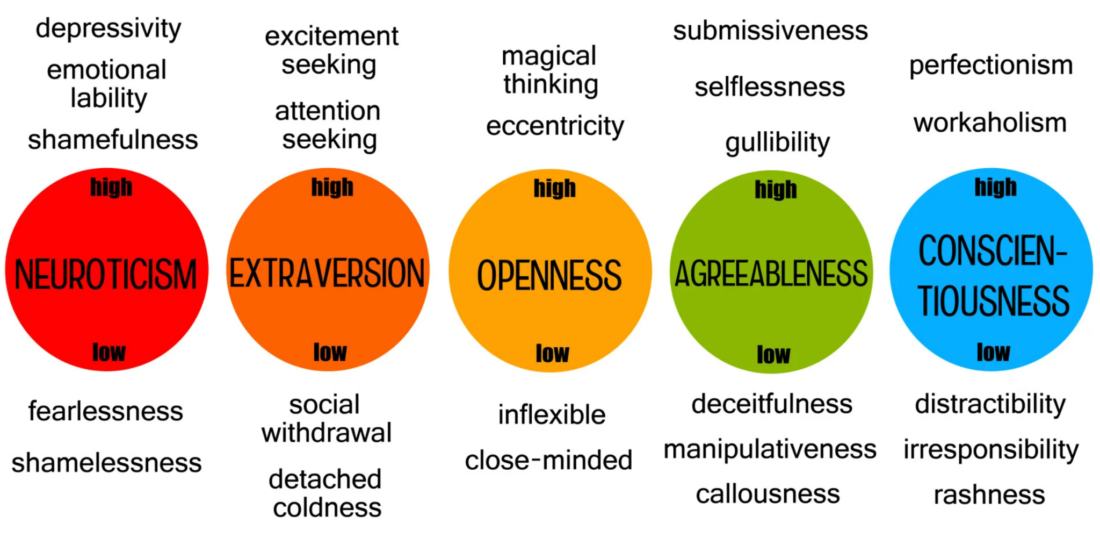
These five dimensions capture patterns in how people typically think, interact, and respond to challenges. Because these patterns remain relatively stable over time, they can offer meaningful insights into workplace behavior. Many modern employee personality tests are based directly or indirectly on these five dimensions.
Other Popular Workplace Personality Assessments
While the Big Five provides a foundational scientific model, many workplace assessments translate these psychological insights into formats that are easier for organizations to apply.
Several widely used tools build on similar concepts while emphasizing different workplace applications:
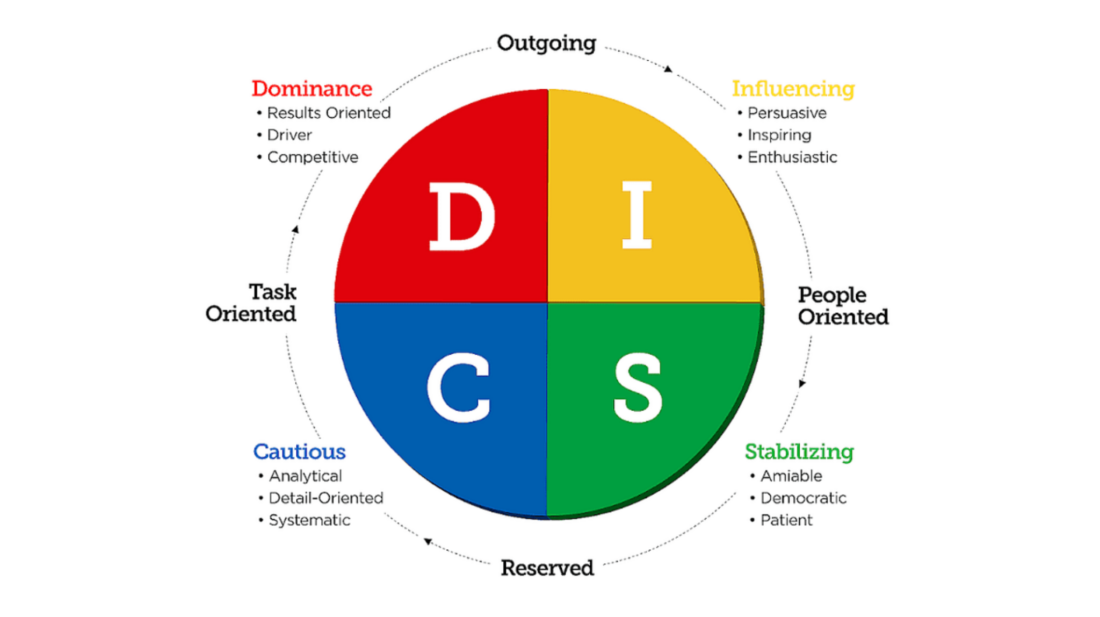
DISC
The DISC assessment focuses on behavioral tendencies and communication style. It categorizes behavior into four primary patterns: dominance, influence, steadiness, and conscientiousness. Organizations often use DISC in team-building workshops or leadership training because it provides a practical framework for understanding how people interact and communicate.
Myers-Briggs Type Indicator (MBTI)
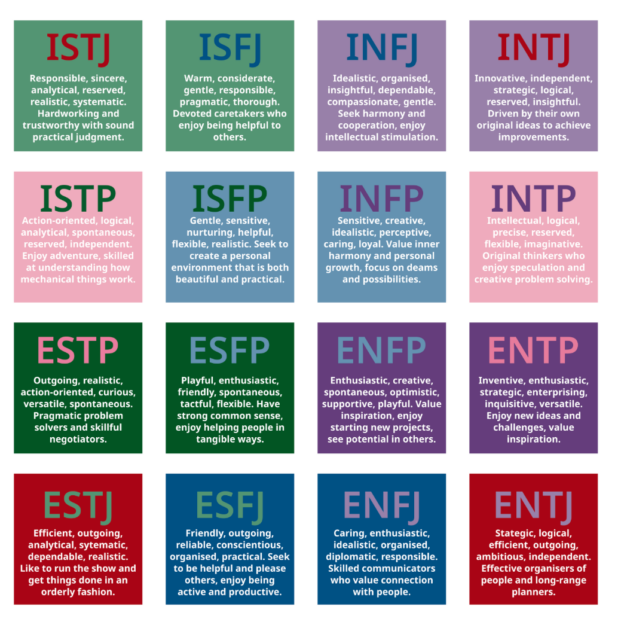
The Myers–Briggs assessment groups individuals into personality “types” based on preferences such as introversion versus extraversion or thinking versus feeling. Although MBTI is widely known and frequently used in professional development settings, it emphasizes personality preferences rather than measurable traits.
Hogan Assessments
Hogan assessments focus specifically on workplace performance and leadership behavior. These assessments evaluate how personality traits influence leadership effectiveness, career success, and potential derailers like patterns of behavior that may appear under stress.
Although these tools differ in structure and terminology, many of them are still grounded in the same core psychological idea: consistent personality traits influence how people behave at work.
The Enneagram
The Enneagram is another widely used framework, especially in leadership coaching and team development. It organizes personality into nine distinct types, each associated with core motivations, fears, and patterns of thinking. Unlike trait-based models, which focus on observable characteristics, the Enneagram aims to explain the underlying drivers behind behavior. For example, some individuals may be motivated by achievement, while others prioritize security, relationships, or personal growth.
In workplace settings, the Enneagram is often used to:
- Build self-awareness among leaders and teams
- Improve empathy and interpersonal understanding
- Explore how motivations influence communication and decision-making
That said, it’s important to note that the Enneagram is less scientifically validated than models like the Big Five. Because it categorizes individuals into types and has limited empirical support in predicting job performance, it is typically not used for personality assessments for hiring.
Instead, it works best as a development tool, complementing more research-backed assessments by adding insight into personal motivations and interpersonal dynamics.
Although these tools differ in structure and application, they are all rooted in a shared idea: consistent personality patterns shape how people behave at work.
For HR teams, understanding these differences is key. Some assessments are better suited for hiring and prediction, while others are more effective for team building, communication, and leadership development. The most effective strategies often combine both, using scientifically validated tools for decision-making and development-focused models to deepen self-awareness and collaboration.
Trait-Based vs. Type-Based Assessments
When evaluating personality assessments for hiring or development, HR professionals often encounter two different approaches: type-based assessments and trait-based assessments.
Understanding this distinction can help organizations choose the right tool for their needs.
Type-Based Assessments
Type-based assessments classify individuals into distinct personality categories. For example, someone might be identified as an “introvert” or an “extrovert,” or assigned to a specific personality type.
In practice, this might look like a team using the Myers-Briggs framework, where an employee is identified as an ENTJ (often described as a decisive, strategic leader), while another team member is categorized as an ISFP (typically seen as thoughtful, adaptable, and detail-oriented). These labels give teams a shared language to quickly understand different working styles and perspectives.
Because these frameworks simplify personality into recognizable categories, they are often easier to interpret and discuss. This is why they are commonly used in team workshops and leadership development programs, where the goal is to build awareness and improve communication rather than make predictive hiring decisions.
Trait-Based Assessments
Trait-based assessments, on the other hand, measure personality along a continuum. Instead of placing someone into a single category, they evaluate where an individual falls along a range of traits.
For example, rather than labeling someone as an extrovert, a trait-based assessment might measure how high or low they score on the extraversion spectrum.
From a scientific perspective, trait-based models tend to provide more nuanced and reliable insights because they reflect the reality that personality traits exist in degrees rather than fixed categories.
For HR teams, this distinction matters. Understanding whether an assessment uses trait measurements or personality types can influence how results are interpreted and applied in areas such as personality assessments for hiring, leadership development, and team building.
When used thoughtfully, these frameworks provide a structured way to understand personality patterns, and ultimately help organizations make more informed decisions about people.
Why Personality Assessments Work for Hiring
Hiring decisions often rely heavily on resumes and interviews. While these tools provide useful information, they have limitations.
Resumes show experience, but they rarely reveal how someone approaches work or interacts with others.
That’s where personality assessments for hiring can provide additional insight.
Going Beyond the Resume
Personality assessments help employers evaluate:
- Communication style
- Motivation drivers
- Decision-making tendencies
- Collaboration preferences
- Stress response
These insights can reveal potential strengths or challenges before a new employee even starts.
Why Employers Screen Applicants Using Personality Assessments
There are several reasons why a prospective employer might screen applicants using a personality assessment.
Organizations often want to understand:
- Whether a candidate’s work style fits the role
- How they might interact with teammates
- Whether they align with company culture
For example, a customer service role may benefit from candidates who score higher in agreeableness and emotional stability, while a sales role may favor extraversion and assertiveness.
Important Guardrails
While personality assessments are powerful tools, they should never be used as the sole hiring criterion.
A best practice is to combine assessments with:
- Structured interviews
- Skills testing
- Work samples
- Reference checks
Organizations must also ensure assessments comply with employment laws and fair hiring practices.
The U.S. Equal Employment Opportunity Commission (EEOC) provides guidelines on lawful pre-employment testing.
Why Personality Assessments Work for Team Building
Personality differences are one of the most common sources of workplace conflict.
Some employees prefer structured processes, while others thrive in flexible environments. Some communicate directly, while others take a more diplomatic approach.
Every team includes people who think, communicate, and approach problems in different ways. While this diversity can be a major strength, it can also become a source of misunderstanding if those differences are not recognized.
Building Complementary Teams
One of the most valuable outcomes of personality assessments is the ability to build balanced teams rather than uniform ones.
When teams consist entirely of similar personalities, they may communicate easily but struggle with blind spots in decision-making or problem-solving. Diverse personality styles, on the other hand, can bring a wider range of perspectives to complex challenges.
Using personality assessments for team building helps leaders intentionally create these complementary dynamics.
Improving Communication
Another powerful benefit of team assessments is the clarity they bring to everyday communication.
Many workplace misunderstandings occur simply because employees interpret messages differently. What one person sees as constructive feedback, another might perceive as criticism. What one employee views as decisive leadership, another may interpret as abruptness.
When teams review personality assessment results together, these patterns become easier to understand.
Why Personality Assessments Work for Leadership Development
Leadership effectiveness is closely tied to self-awareness.
Leaders influence team morale, decision-making, and organizational culture every day. Yet many leaders receive limited structured feedback about how their personality traits affect others.
Personality assessments provide a structured way to uncover those patterns.
A leadership personality assessment helps leaders understand how their natural tendencies shape the way they communicate, make decisions, and respond to challenges. With this insight, leaders can begin to refine their approach and develop new skills more intentionally.
Surfacing Leadership Strengths
Every leader brings a unique set of personality strengths to their role.
Some leaders naturally excel at motivating others and communicating a vision. Others may be particularly strong at analytical thinking, strategic planning, or maintaining calm under pressure.
Leadership assessments often highlight tendencies such as:
- Risk tolerance and comfort with uncertainty
- Decision-making speed and style
- Preferred communication approaches
- Emotional regulation and stress response
When leaders understand these patterns, they can lean into their natural strengths while also recognizing how those strengths influence their leadership style.
Identifying Blind Spots
Equally important, personality assessments can reveal potential blind spots that may limit leadership effectiveness.
Traits that serve leaders well in some situations may create challenges in others.
For example, a leader who scores high in decisiveness may move quickly during critical moments, but occasionally appear impatient with slower decision-making processes. In another instance, a highly confident leader may inspire trust in their team, but sometimes overlook valuable input from others.
Recognizing these patterns allows leaders to adapt their behavior more intentionally. When paired with coaching or mentorship, personality insights often become the starting point for meaningful leadership growth.
Supporting Succession Planning
Many organizations also use personality assessments as part of their succession planning strategies.
Leadership roles require more than technical expertise. They demand the ability to communicate effectively, navigate uncertainty, and build strong relationships across teams.
By analyzing personality traits alongside performance data, organizations can identify employees who may have strong potential for future leadership positions. These insights allow companies to invest in leadership development earlier and prepare employees for greater responsibilities over time.
Choosing the Right Personality Assessment and Platform
With dozens of assessment tools available today, selecting the right one can feel overwhelming. Not all personality tests are designed with workplace applications in mind, and their quality can vary significantly.
For HR teams, choosing an assessment should begin with a few critical questions.
- Is the assessment scientifically validated and supported by research?
- Does it measure traits that are relevant to workplace behavior?
- Can the results be applied to hiring, employee development, or team collaboration?
- Is the assessment platform easy to administer, interpret, and scale across the organization?
Answering these questions helps organizations narrow their options and focus on tools that will provide meaningful insights.
Some companies choose established assessment frameworks, while others prefer to create custom assessments tailored to their specific roles, culture, or leadership competencies.
Platforms like Agolix make it possible to design, deploy, and analyze customized assessments for hiring, training, and employee development.
For example, organizations can create assessments that evaluate:
- Personality traits
- Behavioral tendencies
- Leadership potential
- Workplace preferences
Because these assessments can be tailored to an organization’s specific needs, they allow HR teams to gather insights that directly support their hiring strategies and development programs.
Organizations interested in experimenting with their own employee personality assessment can start by building a customized assessment within a flexible platform.
5 Common Mistakes HR Professionals Make with Personality Assessments
Personality assessments can be powerful tools for understanding employees and improving workplace decisions. However, like any tool, their effectiveness depends on how they are used.
Over time, researchers and HR practitioners have identified several common mistakes organizations make when introducing personality assessments into hiring or development programs.
1. Treating Results as Labels
One of the most common pitfalls is treating personality results as labels rather than useful insights.
Personality assessments are designed to highlight tendencies and behavioral patterns, not to place individuals into permanent categories. People are capable of adapting their behavior depending on context, experience, and organizational culture.
For example, someone who scores lower on extraversion may still thrive in collaborative environments when given the right support and structure. The goal of an employee personality assessment is not to define someone’s limits, but to better understand their natural working style.
When organizations interpret results as flexible insights rather than strict classifications, assessments become far more useful for development and collaboration.
2. Ignoring Scientific Validity
Another mistake occurs when organizations adopt personality tests without evaluating their scientific credibility.
Not all assessments on the market are grounded in psychological research. Some tools rely on loosely defined personality categories or lack proper statistical validation.
Choosing scientifically grounded assessments ensures that insights are not only interesting, but also meaningful for real workplace decisions.
3. Skipping the Debrief
Assessment results are most valuable when employees discuss and interpret them together.
A structured debrief, whether through a team workshop, coaching session, or leadership discussion, helps employees interpret their results and understand how to apply them in their daily work.
These conversations often provide practical takeaways, such as how team members prefer to receive feedback or how different personalities approach problem-solving.
4. Using the Wrong Assessment for the Wrong Purpose
Not all personality assessments are designed for the same objective.
Some assessments are specifically built for pre-employment screening, while others are intended for leadership development, coaching, or team dynamics. Using the wrong tool for the wrong context can lead to misleading interpretations.
Clarifying the intended purpose of an assessment, whether for hiring, development, or team collaboration, helps organizations select the right tool for the job.
5. Collecting Data but Never Acting on It
Finally, one of the most overlooked mistakes is gathering assessment data without integrating it into real workplace decisions.
Personality insights become valuable only when they influence action. That might include adjusting communication approaches within a team, tailoring leadership development plans, or improving role alignment during hiring.
When assessment results sit unused in reports or dashboards, organizations miss the opportunity to translate psychological insight into meaningful organizational improvement.
How to Create a Personality Assessment Grounded in Research With Agolix
For organizations that want to move beyond off-the-shelf tools, building a custom assessment can be a powerful next step. The key is to approach assessment design with a solid level of intention and goal-setting. Below are some best practices.
1. Start with a Clear Purpose
Before writing a single question, it’s important to define what the assessment is meant to achieve.
Are you trying to improve hiring decisions, support leadership development, or strengthen team collaboration?
Each use case requires a slightly different approach. For example:
- Personality assessments for hiring should focus on traits linked to job performance
- Leadership assessments may emphasize decision-making style and emotional regulation
- Team assessments often prioritize communication and collaboration preferences
A clear objective ensures the assessment measures what actually matters.
2. Base Your Assessment on Proven Constructs
Rather than inventing entirely new personality categories, effective assessments are grounded in established psychological constructs, such as the Big Five personality traits.
This doesn’t mean you need to replicate an academic model exactly. Instead, you can adapt proven dimensions, like conscientiousness or extraversion, into questions that reflect your organization’s specific roles and culture.
Grounding your assessment in research helps ensure it measures real, consistent patterns of behavior, rather than surface-level preferences.
3. Write Questions That Measure Tendencies, Not Ideals
One common mistake in assessment design is asking questions that lead respondents toward “ideal” answers.
For example, most candidates will agree with statements like “I am a hard worker.”
Instead, effective personality questions focus on specific tendencies and trade-offs, such as:
- “I prefer to plan tasks in detail before starting”
- “I feel energized when working in group settings”
- “I make decisions quickly, even with limited information”
These types of questions are more likely to reveal authentic patterns of behavior.
4. Use Scales, Not Categories
To improve accuracy, responses should be measured along a scale (for example, strongly agree to strongly disagree) rather than simple yes/no answers.
This approach reflects how personality actually works, and aligns with more scientific trait-based assessments.
5. Test for Reliability and Consistency
Even a well-designed assessment needs to be tested.
Organizations should evaluate whether results are:
- Consistent over time (reliability)
- Aligned with real-world outcomes (validity)
For example, do employees who score high in certain traits consistently perform well in specific roles? Do results remain stable when retaken?
These checks help ensure the assessment produces meaningful insights rather than random variation.
6. Turn Insights Into Action
Finally, the most important step is connecting assessment results to real decisions.
A well-designed employee personality assessment should inform:
- Hiring and role alignment
- Team composition and communication strategies
- Leadership development plans
Without this step, even the most scientifically grounded assessment risks becoming just another unused data source.
Put Personality Insights Into Action With Agolix
Personality assessments deliver the most value when they’re applied with a clear purpose. Whether that’s improving hiring decisions, strengthening team collaboration, or developing more effective leaders, the key is to start focused and build from there.
With platforms like Agolix, you can design and deploy customized assessments that measure personality traits, behavioral tendencies, and leadership potentia—all in one place.
Get started here today building assessments tailored to your organization’s roles, culture, and goals.