



Imagine building an assessment to measure leadership potential, only to discover it primarily measures communication confidence. The results may look professional, but if they measure the wrong thing, they can undermine your credibility and lead to poor hiring, coaching, or development decisions.
That’s where assessment validity and reliability come in. Validity asks whether you’re measuring the right thing, while reliability asks whether you’re measuring it consistently. Although the terms are often confused, both are essential for creating assessments people can trust.
In this guide, we’ll explain what makes an assessment valid and reliable, why these principles matter in business, and how you can apply them when building your own assessments.
What Is Assessment Validity?
Assessment validity refers to how well evidence supports the interpretation and intended use of an assessment’s results. In simpler terms, does your assessment actually measure what you claim it measures?
Think about visiting a doctor with persistent headaches. If the doctor orders a hearing test, the test might function perfectly, but it may not provide the information needed to understand your symptoms.
Assessments work similarly. If you’re developing a leadership assessment, questions about workplace satisfaction alone won’t necessarily tell you whether someone demonstrates effective leadership behaviors.
What Is a Valid Assessment in Practice?
It’s important to remember that validity isn’t a permanent label attached to an assessment.
An assessment can be appropriate for one purpose, but unsuitable for another.
For example, a communication-style assessment might provide useful insights for coaching conversations. However, using those same results as the sole basis for promoting someone into management requires additional evidence that the scores support that particular decision.
The validity of assessment results depends on their intended interpretation, audience, context, and application.
The Standards for Educational and Psychological Testing, published jointly by AERA, APA, and NCME, ground validity in evidence supporting specific interpretations and uses of test scores.
The takeaway? Before asking whether an assessment is valid, ask what decisions its results are supposed to support.
What Is Assessment Reliability?
Assessment reliability is about consistency.
A reliable assessment produces sufficiently consistent results when the characteristic being measured hasn’t meaningfully changed and the assessment conditions are comparable.
Think about a bathroom scale. You step onto it three times within five minutes and receive three dramatically different readings. Even if one measurement happens to be accurate, you have little reason to trust the scale.
The same principle applies to business assessments.
Imagine a consultant administering a workplace resilience assessment twice within a short period. If participants receive wildly different scores despite no meaningful changes in their circumstances, the assessment may have a reliability problem.
Reliability can involve several forms of consistency:
- Test-retest reliability: Are results reasonably stable across repeated administrations when the underlying characteristic remains unchanged?
- Internal consistency: Do questions designed to measure the same characteristic work together coherently?
- Inter-rater reliability: When human evaluators are involved, do different evaluators produce reasonably consistent judgments?
Not every assessment requires every type of reliability evidence. The appropriate approach depends on what you’re measuring and how the results will be used.
A daily mood check-in is supposed to change from day to day, so shifting results isn’t a reliability problem.
Validity vs. Reliability in Assessment: What’s the Difference?
The difference between validity and reliability is easiest to see on a dartboard.
Picture someone throwing darts. Validity is whether they’re hitting the right target: the bullseye represents what your assessment is supposed to measure. Reliability is whether they hit the same spot throw after throw.
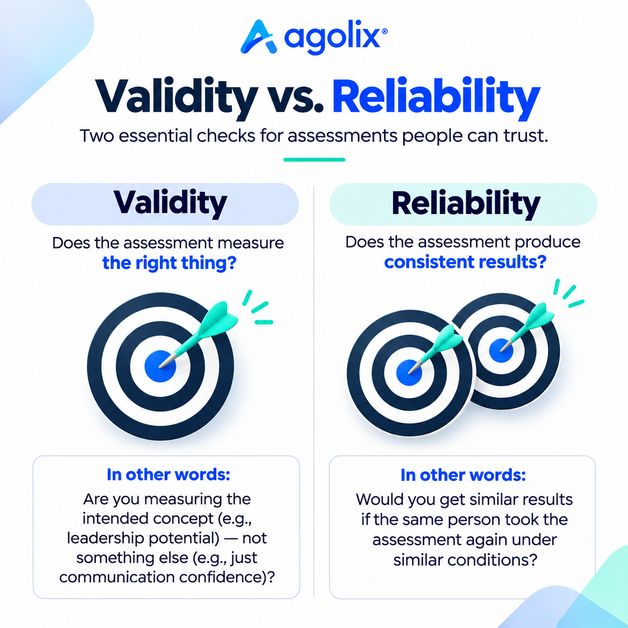
Now imagine a thrower who lands every dart in the same outer ring. That’s reliable, but not valid: consistent, but consistently off target. Assessments can do the same thing, producing stable scores that measure the wrong thing.
An assessment can be reliable without being valid for its intended purpose. However, an assessment cannot meaningfully support a valid interpretation if its results are too inconsistent to trust.
| Concept | What it measures | Key question |
| Validity | Whether results support the intended measurement and use | Are we measuring the right thing? |
| Reliability | Consistency of measurement | Are we measuring it consistently? |
Why Do You Need Both?
Suppose your consulting business uses an assessment to identify employees ready for leadership development. The questions consistently measure confidence in public speaking. Participants receive similar results whenever they complete it.
That’s evidence of consistency, but public-speaking confidence isn’t equivalent to leadership readiness.
Without appropriate validity evidence, reliable results can still produce misleading recommendations.
Validity and reliability work together. One helps establish that your measurement is meaningful; the other helps establish that it’s dependable.
The 4 Main Types of Assessment Validity
Understanding the different types of validity evidence can help you evaluate existing assessments and improve your own.
Although modern measurement standards treat validity as a unified concept supported by multiple sources of evidence, the following four traditional categories offer a useful starting point.
1. Face Validity
Face validity refers to whether an assessment appears relevant and appropriate to the people taking or reviewing it.
For example, a workplace communication assessment containing questions about listening, giving feedback, and managing disagreements will likely appear relevant to participants.
An assessment filled with unrelated questions about other topics probably won’t.
Face validity can influence participant confidence and engagement, but appearances alone don’t establish scientific validity.
2. Content Validity
Content validity examines whether an assessment adequately covers the full scope of what it’s intended to measure.
Imagine creating a customer service competency assessment.
If every question focuses on friendliness but ignores problem-solving, communication, and conflict resolution, you’re leaving important aspects of the role unmeasured.
Content validity requires defining the subject clearly and ensuring your questions represent its important dimensions.
3. Criterion-Related Validity
Criterion-related validity considers how assessment results relate to meaningful external outcomes.
For example, an organization might investigate whether scores on a sales competency assessment are associated with independently measured sales performance.
Two common approaches are:
- Concurrent validity: Comparing assessment scores with relevant outcomes measured around the same time.
- Predictive validity: Examining whether assessment scores are associated with meaningful future outcomes.
A strong relationship can provide useful evidence, provided the external outcome is appropriate and the study is designed carefully.
4. Construct Validity
Construct validity concerns whether evidence supports the claim that an assessment measures an underlying characteristic or concept.
Examples of constructs include resilience, motivation, emotional intelligence, and leadership confidence.
Because these characteristics cannot always be observed directly, assessment designers must define them carefully and gather evidence supporting their interpretation.
For instance, if you’re measuring workplace resilience, your questions should reflect relevant behaviors and responses to challenges rather than simply measuring optimism.
Construct validity draws on multiple forms of evidence, including content, relationships with other measures, and response patterns.
2 Common Ways Assessments Miss the Mark
Even thoughtfully designed assessments can produce misleading results when important elements are overlooked.
Two particularly useful concepts to understand are construct under-representation and construct-irrelevant variance.
Construct Under-Representation
This happens when an assessment fails to capture important parts of the characteristic it’s supposed to measure.
Imagine evaluating management effectiveness using only questions about delegation.
Delegation matters, but management also involves communication, decision-making, accountability, and employee development.
By leaving these dimensions out, the assessment provides an incomplete picture.
How to avoid it: Clearly define the characteristic you’re measuring and map your questions against its essential components.
Construct-Irrelevant Variance
This occurs when unrelated factors influence assessment scores.
For example, imagine administering a problem-solving assessment that uses unnecessarily complicated language.
Participants with strong problem-solving abilities might score poorly because they struggle with the wording rather than the actual problems.
Similarly, an assessment delivered through an inaccessible interface may introduce barriers unrelated to the skill being evaluated.
How to avoid it: Use clear language, remove unnecessary complexity, consider accessibility, and review whether each question measures the intended characteristic.
Why Assessment Validity and Reliability Matter for Your Business
Validity and reliability aren’t just academic concerns. They directly affect the quality of decisions you make and the value you deliver to clients.
Builds Trust With Clients and Stakeholders
When someone completes your assessment, they’re trusting you to interpret their responses responsibly.
A valid and reliable assessment helps build that trust by giving coaches, consultants, and HR professionals a more objective foundation for their recommendations. Rather than relying solely on assumptions or personal opinions, they can explain how specific responses connect to identified strengths, challenges, and opportunities for improvement.
Transparency also matters. When clients understand what an assessment measures, how their results are determined, and why certain recommendations are made, they’re more likely to feel confident in the process and take action.
Over time, consistently delivering relevant, evidence-based insights can strengthen professional credibility, deepen client relationships, and demonstrate the value of your expertise.
Supports Better Business Decisions
Reliable, appropriately validated assessment data can help organizations make more informed decisions about hiring, development, team dynamics, and professional growth.
For example, a leadership coach can use relevant assessment findings to identify development priorities rather than relying entirely on assumptions or first impressions.
Strengthens Professional Credibility
With so many online quizzes promising quick insights, it can be difficult for clients to distinguish meaningful assessments from tools designed primarily for engagement. While these quizzes can be entertaining, they may lack the research, testing, or clear methodology needed to support reliable conclusions.
A well-designed assessment helps set your services apart. By using clearly defined objectives, relevant questions, consistent scoring, and documented testing, you demonstrate that your recommendations are grounded in a thoughtful, structured approach rather than guesswork.
This also makes your expertise more tangible. Instead of simply telling clients you can identify their challenges, you can show them how your assessment evaluates specific areas, uncovers potential gaps, and informs personalized recommendations.
When clients and stakeholders can understand the reasoning behind your results, they’re better equipped to evaluate and trust your expertise. Over time, this transparency and consistency can strengthen your professional reputation and position your assessment as a valuable part of your services.
Reduces Unnecessary Risk
Poorly designed assessments can introduce bias, exclude qualified individuals, or encourage unsupported conclusions.
This is particularly important in employment settings, where assessment practices may be subject to legal and regulatory requirements.
The U.S. Equal Employment Opportunity Commission provides guidance on employment tests and selection procedures, including considerations relating to job relevance and discriminatory impact.
Assessments should support informed professional judgment, not automatically replace it.
How to Make Your Own Assessment More Valid and Reliable
You don’t necessarily need a dedicated research department to start improving assessment quality.
These five practical steps can help you create a stronger foundation.
1. Define Exactly What You’re Measuring
Start with a clear objective.
Instead of deciding to create a general leadership assessment, identify the specific leadership characteristics you want to explore.
Are you measuring communication, accountability, decision-making, or conflict management?
Clearly establish what’s included and excluded before drafting questions.
2. Align Every Question With Its Purpose
Each question should contribute meaningful information about the characteristic you’re measuring.
Create a simple assessment blueprint connecting your objectives to individual questions.
If a question doesn’t clearly support an objective, consider revising or removing it.
3. Write Clear, Unbiased Questions
Avoid jargon, biased questions, leading statements, and unnecessarily complicated wording.
“Instead of asking, ‘Do you consistently communicate effectively and successfully resolve interpersonal disagreements?’, split it into two questions: ‘How often do you communicate expectations clearly?’ and ‘How effectively do you resolve disagreements with colleagues?’”
Clear wording helps participants understand what’s being asked and reduces irrelevant influences on their responses.
4. Pilot, Review, and Refine
Before launching an assessment widely, test it with a group resembling your intended audience.
Ask participants whether questions are understandable, review response patterns, and identify items that aren’t performing as expected.
Where appropriate, examine consistency and relationships with relevant external measures.
Use your findings to refine the assessment before broader implementation.
The International Test Commission also provides professional resources and guidelines supporting responsible testing practices.
5. Keep Assessment Conditions Consistent
Standardizing your assessment supports reliability.
Use consistent instructions, response options, scoring rules, and delivery conditions whenever comparisons between participants are intended.
If one participant receives detailed explanations while another receives none, their results may become less comparable.
Consistency becomes especially important when multiple coaches, consultants, or HR teams administer the same assessment.
A Note on “Proving” Validity and Reliability
You’ve probably encountered assessments advertised as “scientifically valid and reliable.”
But what evidence supports those claims?
Responsible assessment providers should be able to explain how their instruments were developed, tested, and evaluated.
Depending on the assessment’s purpose useful evidence might include documented research methods, appropriate sample sizes, reliability estimates, expert reviews, and studies connecting scores with relevant outcomes.
Evidence should also reflect the intended audience and use.
A tool studied among university students, for example, isn’t automatically validated for executive hiring. For business professionals building their own assessments, the goal is to apply an appropriate level of rigor.
Begin with clear definitions, relevant questions, small-scale pilot testing, transparent limitations, and ongoing refinement.
Remember, validity isn’t something you establish once and never revisit. It’s an ongoing process of gathering evidence that your assessment results support their intended use.
Building Valid, Reliable Assessments in Agolix
Understanding assessment design is one thing, but putting those principles into practice is another.
That’s where having the right assessment-building platform can make a difference.
Agolix helps coaches, consultants, and business professionals create online assessments that support their services and client experiences.
Rather than relying on disconnected forms and manual processes, you can build a structured assessment experience around your specific objectives.
Create Consistent Scoring and Results
Clearly defined scoring and assessment logic help ensure participants’ responses are evaluated according to the same rules.
While consistent automated scoring doesn’t independently establish validity, it can reduce avoidable inconsistencies in how results are calculated and presented.
Test and Improve Your Questions
Start with a focused assessment, pilot it with representative participants, and review their feedback.
Use those insights to improve unclear questions, identify missing dimensions, and strengthen alignment between your objectives and results.
Assessment quality develops through deliberate testing and refinement, not simply through choosing a platform.
Standardize Your Assessment Experience
Once you’ve developed and tested an assessment, using a consistent version helps maintain comparable administration as your business grows.
That means you can focus more attention on interpreting results and helping clients take meaningful action.
Whether you’re developing a coaching diagnostic assessment, employee development tool, or business assessment, Agolix provides a practical starting point for turning your expertise into an online assessment experience.
Ready to create an assessment your clients can use with confidence? Explore Agolix and start your free trial to begin building, testing, and refining your own assessments.
Measure What Matters, Consistently
A trustworthy assessment needs two essential qualities.
Validity helps establish that results meaningfully represent what you intend to measure. Reliability helps establish that those results are sufficiently consistent to support interpretation.
You need both.
For coaches, consultants, HR professionals, and business experts, understanding these principles means creating assessments that offer more than interesting scores.
It means building tools that support clearer conversations, more informed recommendations, and better professional decisions.
Start with a clear purpose, develop relevant questions, test your approach, and continue improving it as you gather evidence.
Your clients are relying on the insights you provide. Make sure your assessments give those insights a dependable foundation.
Start building your assessment with Agolix today.