



A client completes an assessment, carefully considers their responses, and receives an assessment report filled with scores, insights, and recommendations.
Then… nothing changes. The report gets saved, more urgent work takes over, and valuable feedback never turns into action.
The problem here isn’t a lack of useful insight, but the gap between understanding the results and knowing what to do next. For coaches, consultants, and HR professionals, an effective assessment report should do more than present findings.
In this post, you’ll learn how to design assessment reports that people actually read, understand, and use. We’ll cover report structure, actionable recommendations, effective debriefs, follow-up, and a practical assessment report template you can adapt to turn feedback into meaningful next steps.
What Makes an Assessment Report “Actionable” (and Why Most Aren’t)
An assessment report is a document that organizes assessment results, explains what those results mean, and communicates findings to the person or organization being assessed.
An actionable assessment report goes one important step further: it makes the reader’s next move clear.
That’s where assessment reporting can go wrong. It’s easy to focus on accurately displaying scores, benchmarks, charts, and written interpretations. All of that information can be useful, but reporting information isn’t the same as directing action.
Think about the process in reverse.
Instead of asking, “What information should we put in this report?” start by asking, “What do we want the reader to understand or do after reading it?” That desired outcome should shape the information you include, its order, the language you use, and the recommendations you make.
For example, if a leadership assessment identifies delegation as someone’s biggest development opportunity, the goal isn’t just for the leader to know their delegation score. The report should help them understand the implications of that result, and identify something they can do differently in their next week of work.
That’s the difference between reporting a result and designing for action.
5 Reasons Why Clients Don’t Act on Assessment Results
When people fail to act on assessment results and feedback, it can be tempting to blame motivation. More often, the report itself has created unnecessary friction.
Here are five common assessment report design problems.
1. Data Overload
A 30-page report may contain an impressive amount of information, but more data doesn’t automatically inspire better action.
If every score, competency, benchmark, chart, and recommendation receives equal attention, the reader has to determine what’s important on their own. That’s a significant burden.
Good report design creates hierarchy. It tells readers where to start, and how to proceed.
2. No Prioritization
Imagine an assessment that produces 15 recommendations. Are they all equally important? Probably not.
When everything is presented as a priority, nothing feels like a priority. Identify the two or three findings likely to create the greatest impact, and make sure those are visually and verbally clear.
3. Vague Recommendations
“Improve communication.”
“Become a better listener.”
“Work on strategic thinking.”
These recommendations describe desirable outcomes, but they don’t tell someone what to do next.
A useful recommendation translates an insight into observable behavior. Avoid being vague, and focus on specific, detailed actions someone can take as an immediate next step.
4. No Owner or Deadline
Action becomes much more likely when someone knows who will do what and by when.
This matters particularly in organizational assessments involving multiple stakeholders. “The team should improve feedback” leaves ownership unclear. “The team leader will introduce a 10-minute feedback check-in during weekly meetings beginning next Monday” gives everyone something concrete to work with.
5. Defensive Framing
Assessment results can feel personal, particularly when they challenge someone’s self-perception.
If a report reads like you’re scolding or judging someone, the recipient may spend more energy disputing the finding than learning from it. Try to avoid language that sounds overly accusatory, or even passive aggressive. Use constructive criticism in your feedback and recommendations to drive greater understanding and engagement from the recipient. For example,
- Before: “You fail to delegate.”
- After: “You tend to hold onto tasks others could own. That may be limiting your team’s growth and your time for strategic work.”
These reasons aren’t just client problems; they’re report-design problems. Luckily, each can be addressed deliberately to increase comprehension and action from your clients!
The Anatomy of an Assessment Report That Drives Action
There’s no universal format that works for every assessment. A leadership diagnostic and an organizational culture assessment naturally require different levels of detail.
Still, effective assessment reports tend to share several structural characteristics.
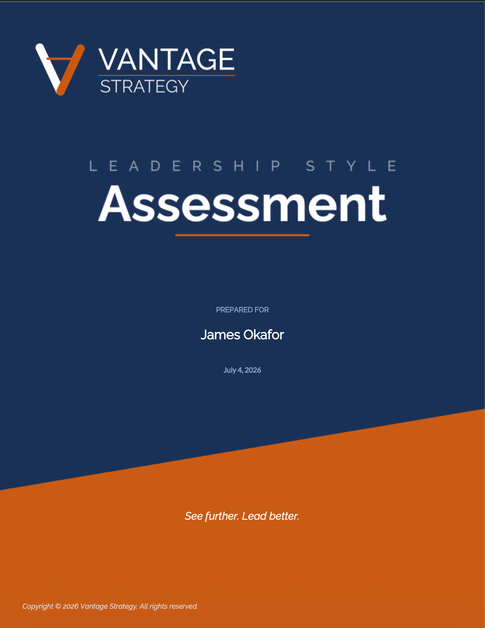
Personalized Cover and Greeting
Personalization immediately signals that the report belongs to the reader.
Include the participant or organization name, assessment name, date, and relevant branding. If appropriate, add a brief personalized greeting.
This seems small, but it helps prevent the report from feeling like generic output generated for anyone who happens to receive it.
Tools such as Agolix can help assessment creators generate individualized reports while maintaining consistent branding and structure.
A “What You’ll Get” Opener
Don’t make readers figure out how to navigate the document.
Use a short opening section to explain:
- What the assessment measures
- Why those measures matter
- How the results were generated
- What the reader will find in the report
- How you recommend using the information
Keep this to the point, with no more than one or two short paragraphs. Remember that you want to help orient your readers, not overwhelm them!
Snapshot First, Detail Second
One of the most useful principles in assessment report design is progressive disclosure: give readers the headline before the details.
Page one or the opening section should answer three questions:
- What did we learn?
- What matters most?
- What should I focus on first?
Then provide supporting scores, charts, interpretations, or item-level detail later.
The Nielsen Norman Group’s research on progressive disclosure explains why presenting essential information first can reduce complexity for users. Although the principle comes from interface design, it’s equally useful when thinking about how readers navigate information-heavy reports.
Theme-by-Theme: Score, Meaning, Next Step
A practical assessment report example might organize each major theme using the same three-part pattern:
- Result: What did the assessment find?
- Meaning: Why does that finding matter in the reader’s context?
- Next step: What can the reader do about it?
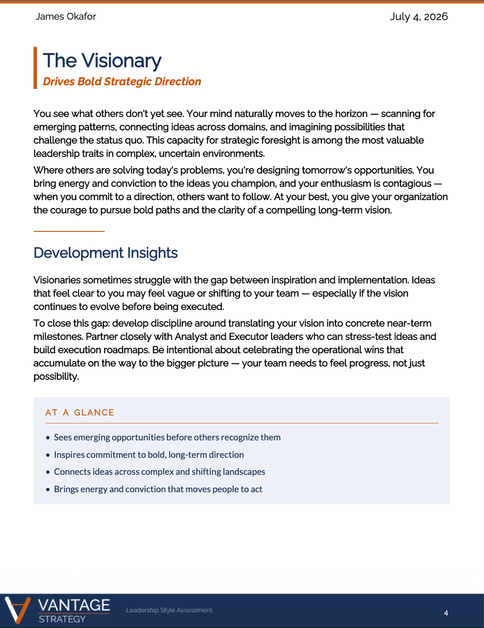
Suppose a manager scores lower in delegation. Instead of stopping at “Delegation: 58/100,” explain how the result may show up at work and provide one practical behavior to test.
Consistent structure also makes longer reports easier to scan.
Prioritized Recommendations, Not a Laundry List
The recommendation section should make choices for the reader rather than handing them another analysis task.
Consider organizing recommendations into categories such as:
- Start now
- Build next
- Longer-term development
Alternatively, identify the “Top 3 Priorities” and explain why each one deserves attention.
Prioritization doesn’t mean the remaining findings are irrelevant. It means you’re helping the reader allocate limited time and attention.
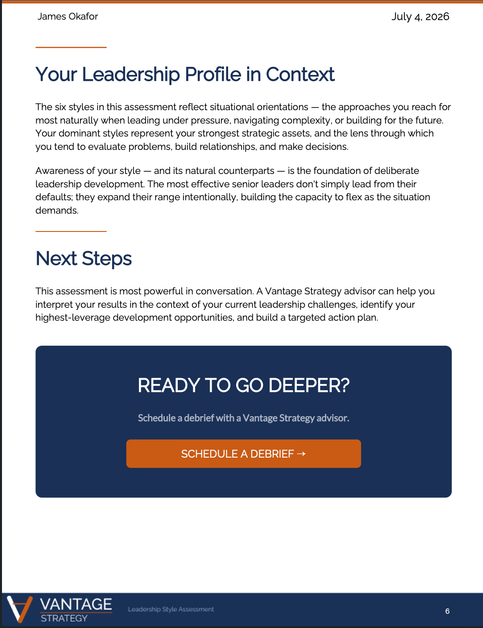
One Clear Next Step and CTA
What should happen immediately after the report?
- Book a coaching session?
- Discuss the findings with a manager?
- Complete an action plan?
Make that action unmistakable.
Don’t end with a final chart and expect the reader to invent the next stage of the process. A strong report creates a bridge from reading to doing.
Writing Assessment Recommendations People Actually Follow
Even a beautifully structured assessment report can fall short if its recommendations aren’t usable. Telling someone they need to “communicate better” or “become a stronger leader” may accurately identify an opportunity, but it leaves the hardest question unanswered: What should I actually do differently?
Good recommendations close that gap. They translate assessment findings into behaviors the reader can realistically put into practice.
The strongest recommendations tend to share five characteristics: they’re specific, prioritized, sequenced, achievable, and connected to a reason the reader cares about.
Make the Action Specific
Start by replacing abstract goals with observable behaviors. The reader should be able to tell exactly what taking action looks like.
Here’s a simple before-and-after example.
- Before: “Improve communication with your team.”
- After: “For the next four weekly team meetings, spend five minutes at the end asking each team member to identify one priority that’s clear and one issue that needs clarification. Review the responses after four weeks and identify recurring communication gaps.”
The second version answers several questions immediately: What should I do? Where should I do it? How often, and for how long? What happens afterward?
Prioritize and Sequence Recommendations
An assessment may uncover several areas for development, but readers shouldn’t be expected to work on everything simultaneously. Too many recommendations can turn an otherwise useful assessment report into another overwhelming to-do list.
To combat this, show them what comes first and what follows.
For example, begin by introducing weekly one-on-one meetings. After four weeks, use patterns from those conversations to identify one delegation responsibility to transfer to each direct report.
Now, the actions form a sequence rather than two unrelated suggestions. This approach also helps coaches and consultants structure future conversations. Instead of asking whether a client completed ten different recommendations, they can focus the next session on one agreed-upon priority and the progress made toward it.
Keep the Action Achievable
An ambitious recommendation that never gets started is less valuable than a modest recommendation that produces a meaningful behavior change.
Recommendations should account for the reader’s role, available time, authority, and current workload. Asking a new manager to “transform team culture,” for example, is far less actionable than asking them to introduce a specific feedback practice over the next month.
Small experiments can work particularly well. They give people an opportunity to test a new behavior, observe what happens, and adjust before making a larger commitment.
Consider including a timeframe or measurable checkpoint whenever it makes sense. “Try this during your next three client meetings” feels more manageable than “Do this from now on.” A defined experiment also creates a natural point for reflection during a coaching session or follow-up assessment.
Explain Why It Matters
People are more likely to act when they understand how a recommendation connects to an outcome they value. A short “why” can turn an instruction into something personally relevant.
For example, “This will help you identify bottlenecks earlier while giving team members greater ownership over their work.” The recommendation now has both an action and a reason to care.
The motivation should also reflect the context of the assessment. A senior leader may care about freeing up time for strategic work, while a new manager may be focused on building trust with their team. The underlying recommendation could be similar, but the reason for acting on it may be different.
Give Every Recommendation an Action Test
Before adding a recommendation to an assessment report, run it through a simple test:
- Is It Specific: Can the reader identify the behavior they’re being asked to change?
- Is It Prioritized: Do they know how important this is compared with other recommendations?
- Is It Sequenced: Is it clear when this action should happen and what follows it?
- Is It Achievable: Can the reader realistically start with their current time, resources, and authority?
- Is It Motivated: Do they understand why taking this action will benefit them?
If a recommendation passes all five, you’ve moved beyond simply describing an assessment result. You’ve given the reader a practical path for doing something with it, and that’s where assessment reporting starts to create real value.
Delivering the Assessment Report: The Debrief Matters as Much as the Document
A strong document is only part of the experience.
When results are nuanced and development-focused, a live debrief can help recipients interpret the information in context. Rather than simply emailing the PDF and hoping for the best, coaches, consultants, and HR professionals can use the report as a conversation tool.
A trusted coach, consultant, or internal leader can also help the recipient separate the finding from assumptions about what it means.
The Center for Creative Leadership offers useful perspectives on the relationship between intention, behavior, feedback, and impact in leadership development.
During the debrief, favor plain language over assessment jargon. Start with strengths where appropriate, too. Strengths-first framing isn’t about avoiding difficult feedback. It creates a more balanced picture and can help the conversation focus on development rather than judgment.
Most importantly, don’t end the meeting with, “Any questions?” End with a commitment. Ask something like, “Based on these results, what’s one action you’re willing to take before we meet again?”
Write it down, assign a date, and make it part of the follow-up.
After the Report: Follow-Up and Accountability
Behavior change doesn’t happen when someone downloads a PDF. To create accountability, build follow-up into the assessment process from the beginning.
What does this look like? A coach might revisit the top recommendation during the next session. An HR leader might schedule a 30- or 60-day check-in. A consultant might use the results to establish milestones for a broader engagement.
Reassessment can be useful, too. Running the assessment again after an appropriate period gives the participant an opportunity to see whether scores and behaviors are moving.
This also creates a natural next stage for coaches and consultants. Instead of treating the assessment as a standalone deliverable, it can become the foundation for a coaching program, workshop, consulting engagement, or development plan.
The goal isn’t follow-up for follow-up’s sake. It’s maintaining momentum long enough for insight to turn into behavior.
Start From a Reusable Assessment Report Template (With a Sample)
You don’t need to reinvent your report every time you run an assessment. A reusable assessment report template can provide consistency, while still leaving room for personalized results and recommendations.
- A practical template might look like this:
- Personalized cover and greeting
- Purpose of the assessment
- Executive results snapshot
- Top strengths
- Top development priorities
- Theme-by-theme results and interpretation
- Specific recommendations
- A 30-, 60-, or 90-day action plan
- Next step and CTA
A sample of an assessment report built this way creates a clear journey: orient the reader, show the big picture, explain the details, prioritize the findings, and finish with action.
Once you’ve developed that structure, automation can remove much of the repetitive work involved in producing personalized reports.
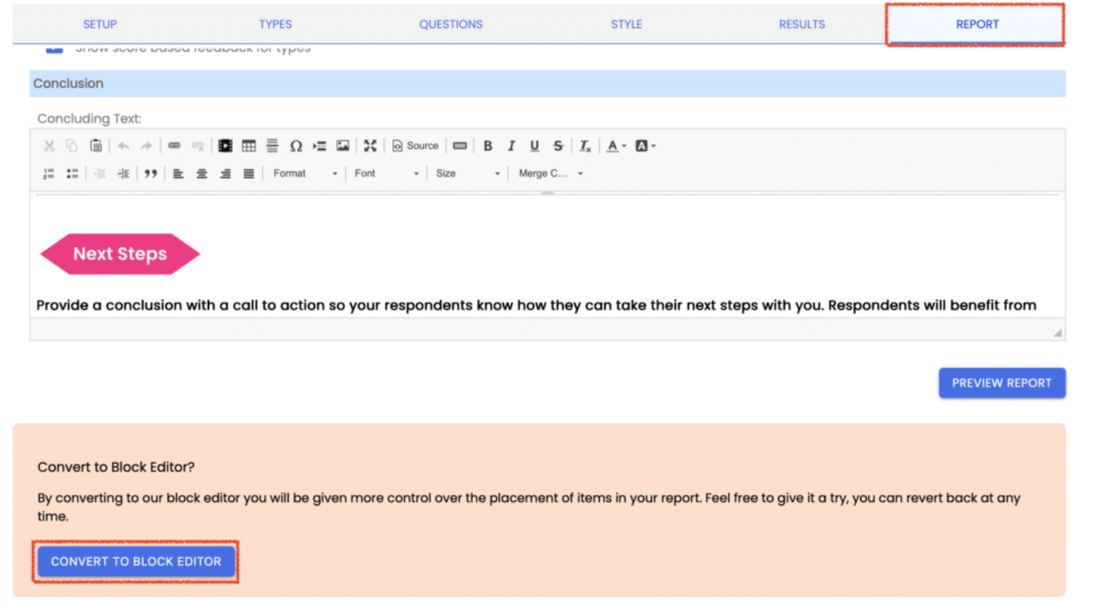
Agolix is designed to help coaches, consultants, and other assessment professionals create online assessments and automatically generate personalized, branded reports from participant responses. Rather than manually copying scores and recommendations into separate documents, you can build the reporting logic into the assessment process.
For more detail on building assessments and reports, explore the Agolix Help Center and Agolix’s assessment software resources.
If you’re currently creating reports manually, or have an assessment idea you want to turn into a repeatable client experience, start with Agolix and explore how automated assessment reporting fits your workflow.
Make the Report the Start, Not the Finish Line
The purpose of an assessment isn’t simply to produce a score, and the purpose of an assessment report isn’t simply to document that score.
The report should create movement.
That means solving the problems that often stop action: too much information, unclear priorities, vague recommendations, missing accountability, and feedback that puts the recipient on the defensive.
Design backward from what you want the reader to do next. Put the most important information first, and pair findings with meaning and specific actions. Prioritize recommendations instead of presenting a laundry list, and then use a thoughtful debrief and follow-up to keep the process moving.
When those pieces work together, assessment reports become more than polished deliverables. They become practical tools for coaching, development, decision-making, and measurable change.
The best part? You don’t have to build every report by hand. With Agolix, you can turn assessment responses into personalized, branded reports and create a clearer path from insight to action.
Start your Agolix free trial today, and build an assessment experience designed around what matters after the results arrive: what your clients do next.