



You know how to get results for your clients. But when prospective clients compare coaches, consultants, and experts, they often see the same promises. Even when your expertise is genuinely different, it can be difficult to show why.
A signature assessment makes that difference tangible. Instead of simply telling prospects about your approach, you help them understand where they are, what’s holding them back, and what to do next. Their results also give you the insights to deliver a truly personalized service.
Below, we’ll show you how to build your signature framework, turn it into an assessment, and use Agolix to create a branded experience that supports your expertise.
What Is a Signature Method (and Why Do Experts Need One)?
A signature method is the clear, repeatable process you use to help clients move from a problem to a desired result.
Chances are, you already have one… even if you’ve never named it.
Think about your most successful client engagements. You probably ask similar questions, look for similar warning signs, address challenges in a particular order, and repeatedly recommend certain actions.
That accumulated know-how is valuable intellectual property (IP). Turning it into a signature framework simply makes the process visible.
For example, imagine a leadership consultant who consistently helps fast-growing companies improve management performance. After reviewing past engagements, she realizes her work repeatedly comes down to four areas:
- Role clarity
- Communication
- Accountability
- Feedback
Instead of selling general “leadership consulting,” she could package those four areas into a named leadership framework.
A clear framework makes it easier for prospects to understand your approach, gives your team a repeatable process to follow, and provides language clients can remember and share.
It can also make conversations less focused on comparing hourly rates. You’re no longer selling only your time; you’re introducing clients to a defined methodology.
There is, however, a limitation. A framework sitting on a presentation slide is still passive. People can understand it, but they can’t interact with it.
That’s where an assessment comes in.
From Framework to Assessment: The Missing Link
Think of your signature framework or method as the map, and your assessment as the “You Are Here” marker.
The framework explains what matters, and the assessment tells a prospective client where they currently stand within it.
This is the step many experts miss.
Suppose our leadership consultant presents her four-part framework to a CEO. It’s useful information, but it’s still generic. The CEO doesn’t yet know whether their company’s biggest issue is role clarity, accountability, communication, or feedback.
Now, imagine the CEO completes a 10-minute leadership assessment first.
Their results show:
- Role Clarity: 82%
- Communication: 68%
- Accountability: 43%
- Feedback: 51%
Suddenly, the framework is about their company in particular. Instead of saying, “I have a leadership development program,” the consultant can say, “Your assessment indicates that accountability is currently the biggest gap, with feedback as a secondary opportunity. Let’s look at why.”
Assessments turn expertise into a diagnostic experience. They can help clients identify needs they haven’t clearly articulated, and give experts structured data for deciding what to recommend next.
McKinsey research found that 71% of consumers expect personalized interactions, and 76% get frustrated when they don’t get them. Those expectations don’t disappear when someone hires a coach or consultant. An assessment gives experts a practical way to meet them.
What Is a Personalized Service?
Personalized service means shaping your work around each client’s situation, priorities and results, rather than giving everyone the same experience.
A generic consulting package might include six workshops, three strategy sessions, and a final action plan for every client.
An assessment-driven personalized service can use the same underlying methodology while changing the emphasis.
A leadership consultant might discover that Client A has strong communication but weak accountability. Client B, meanwhile, has good accountability systems, but managers avoid giving meaningful feedback.
The framework stays the same for both; the assessment shows where each client needs it most.
Combining a repeatable framework with personalized assessment insights creates three key advantages:
1. Relevance
Recommendations address each client’s specific challenges and priorities rather than relying on assumptions. This makes the services more useful and actionable.
2. Trust
Clients can see how recommendations connect to their assessment responses and results. This transparency builds confidence in the consultant’s expertise and approach.
3. Clarity
Instead of receiving a generic list of services, clients understand their current challenges, recommended next steps, and how those steps support their goals.
Together, these advantages help consultants deliver personalized services through a consistent process, making their approach easier to repeat and scale without sacrificing individual client needs.
How to Build Your Signature Framework
You don’t need to invent an impressive-sounding methodology from scratch. In fact, your best framework is probably hiding in work you’ve already done.
Audit Your Best Client Wins
Start by reviewing 5-10 successful client engagements, and look for patterns.
What did those clients struggle with initially? What did you examine first? Which questions did you consistently ask? What changes produced the biggest improvements?
Don’t focus only on what you said you would deliver. Look at what actually happened.
Capture repeated items from these client engagements:
- Problems
- Diagnostic questions
- Steps or activities
- Recommendations
- Turning points
- Outcomes
If you’re used to relying on experience and intuition, breaking down your expertise into a structured process may feel unfamiliar. However, that’s exactly what you’re doing: working backward from the recommendations you make to identify the questions and insights that guide your decisions. This helps you turn your expertise into a repeatable assessment.
Define the Core Problem and Transformation
Next, identify the core transformation you help your clients achieve. Think about the common challenges they face and the outcomes they want, then use those insights to define the overall purpose of your assessment.
A business coach isn’t necessarily selling coaching calls. A sales consultant isn’t selling workshops, and a leadership expert isn’t selling assessments. Those are merely delivery mechanisms.
The client is paying to transform from their current state to a more desirable one.
Try completing this sentence: We help [type of client] move from [current problem] to [desired outcome].
Getting specific here will make the rest of your signature framework much easier to build.
Map and Group Your Steps Into Phases
Next, organize the patterns you’ve identified into a logical structure. Start with a spreadsheet, document, or mind map, grouping similar client challenges, behaviors, and needs into broader categories. These categories can become the core components of your signature framework and help you determine what your assessment should measure.
Most frameworks don’t need 15 stages. Aim for roughly three to seven components that are easy for clients to understand.
Your framework might take the form of:
- Sequential steps
- Strategic pillars
- A maturity model
- A cycle
- A roadmap
- Key dimensions of performance
Our leadership consultant’s four areas are an example of pillars: each is a distinct part of effective leadership she can assess, helping her see where each client needs the most support.
Alternatively, a consultant might structure their framework around phases, such as Diagnose → Prioritize → Implement → Optimize. Unlike pillars, which represent key areas of focus, phases outline the steps clients move through to achieve their desired outcome.
Choosing the right structure matters because it determines how you’ll organize your assessment, interpret results, and guide clients toward meaningful improvements.
Look at how you’ve actually worked with clients, and choose the structure that reflects it.
Name It So It Sticks
Finally, give the framework a name. Instead of clever wordplay, aim for clarity.
A distinctive name makes your method easier to reference in sales calls, workshops, proposals, reports, and marketing.
Give each step a plain-language name, too. If a phase takes five minutes to explain, simplify it.
Your signature framework should make any complicated parts of your services feel easier to grasp, not more complicated.
How to Turn That Framework Into a Signature Assessment
Now, it’s time to take your findings and make your framework interactive. Here are best practices around how to turn your framework into a successful signature assessment.
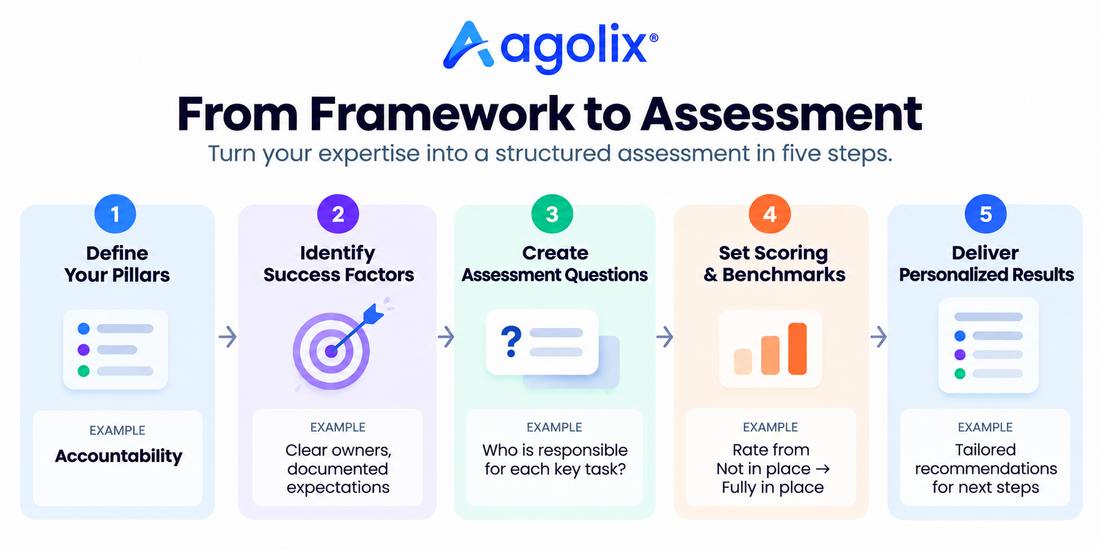
Choose What to Measure
Once you’ve defined your framework’s pillars or phases, the next step is deciding what to measure within each one. Think about the specific behaviors, practices, or outcomes that indicate whether a client is succeeding in that area.
For example, a leadership consultant using accountability as one of their framework’s pillars might look for signs that:
- Responsibilities have clear owners.
- Expectations are documented and understood.
- Managers consistently follow up on commitments.
- Teams establish measurable goals.
- Missed commitments lead to constructive conversations.
These indicators help the consultant turn a broad concept like accountability into something they can assess. For instance, to measure whether managers follow up consistently, they might ask: “How often do you review progress on assigned responsibilities with your team?”
The client’s response provides insight into their current practices, and helps the consultant identify potential areas for improvement.
Repeat this process for each pillar, connecting measurable indicators to relevant assessment questions. This creates a structured way to evaluate client needs and recommend services based on their results.
Write Questions That Map to Your Phases
Every assessment question should have a purpose. Rather than including questions simply because they’re interesting, focus on gathering information that helps you understand a client’s challenges and make relevant recommendations.
Different question types can reveal different insights. Here are four useful options to consider:
- Rating scale questions: Measure perceptions, confidence, or agreement. For example, “How confident are you in your ability to delegate responsibilities effectively?” Responses might range from “Not at all confident” to “Extremely confident.”
- Multiple-choice questions: Identify common challenges or situations. For example, “What’s your biggest obstacle to holding team members accountable?” Options might include unclear expectations, competing priorities, or limited follow-up.
- Frequency-based questions: Explore how regularly certain behaviors occur. For example, “How often do you review progress on assigned responsibilities with your team?” Responses might range from “Never” to “Always.”
- Open-ended questions: Capture context that predefined answers might miss. For example, “What’s one recurring challenge you face when communicating expectations to your team?”
The best question type depends on what you’re trying to learn. Rating scales and frequency questions can help identify patterns, while multiple-choice and open-ended questions provide additional context for personalized recommendations.
Keep your wording clear and neutral, and avoid questions that make one answer seem obviously preferable. Pew Research Center’s guide to writing survey questions offers additional guidance on question wording, order, and reducing bias.
As you develop your assessment, connect each question to a specific pillar, phase, or measurable indicator within your framework. This helps ensure the responses provide useful information rather than simply generating more data.
Design the Scoring and Result Categories
Next, decide how assessment responses will translate into meaningful results. Start by mapping out your scoring system in a spreadsheet, outlining each framework dimension, its related questions, and how different responses contribute to the overall score.
You might calculate separate scores for each framework pillar or group respondents into broader development stages, such as Foundation → Developing → Established → Optimized.
For each category, define what the results mean and what recommendations should follow. For example, a score of 62 isn’t particularly useful on its own. But “Developing: Your accountability processes exist, but they’re inconsistently applied across managers” gives clients something they can understand, discuss, and improve upon.
Once you’ve established your scoring structure, you can build it into an assessment platform like Agolix, where responses can be scored and translated into personalized results. This helps you deliver consistent evaluations while tailoring feedback to each client’s needs.
Craft a Personalized, Branded Report
The report is where your intellectual property becomes visible.
Don’t simply return a score. Explain key areas to your clients, such as:
- What the result means
- What the respondent is already doing well
- Where gaps may exist
- Why those gaps matter
- What they should prioritize
- Recommended next steps
This is also where your own terminology, framework, visual identity, and point of view can shine.
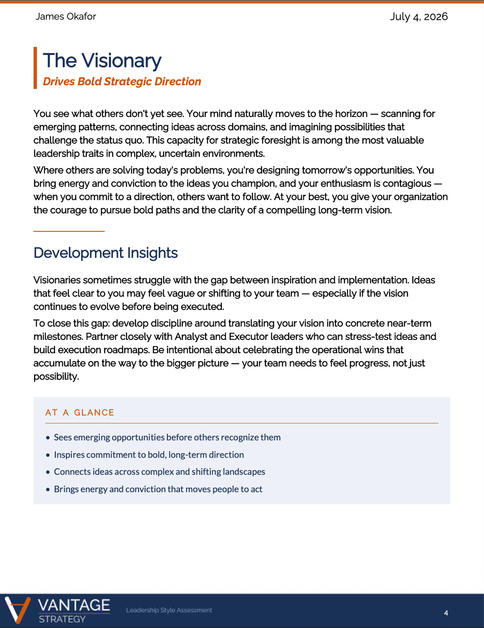
Example: a branded leadership report built in Agolix.
4 Steps for Building Your Signature Assessment in Agolix
Once you’ve worked out what your assessment needs to measure, you need a way to turn it into an experience people can actually complete.
That’s where Agolix comes in. Agolix is online assessment software that helps consultants, coaches, and other experts turn their methods into branded assessments and personalized reports. You can explore sample assessments to see how others have done it.
1. Set Up Your Questions and Logic
Start by creating the questions that map to your signature framework. To do this, you can use Agolix’s AI Assessment Generator, which takes your prompt and turns it into a fully structured assessment draft.
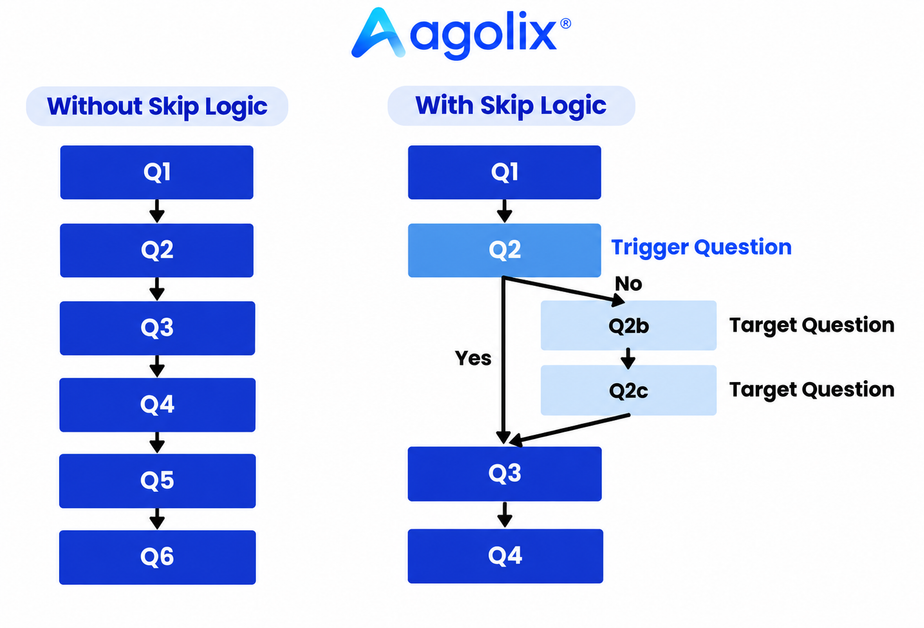
Skip logic lets you route respondents past questions that don’t apply. A CEO who answers “No” to having a formal review process can go straight to follow-up questions about that gap.
Rather than forcing everyone through an unnecessarily long questionnaire, you can design the assessment around the information that matters to the individual.
2. Automate Scoring and Personalize Results
This is where the assessment starts doing more than collecting information.
Instead of manually reviewing every response, build your scoring model around the categories you established earlier.
The respondent can then receive results connected to their answers, framework stage, or diagnostic profile.
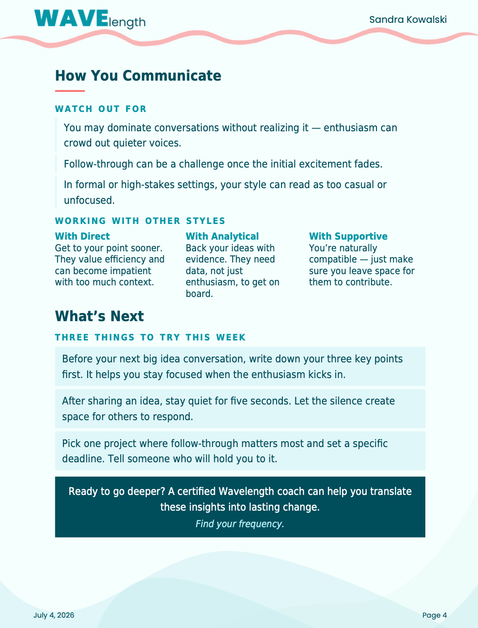
Example: a branded communication report built in Agolix.
3. Brand the Experience
Your signature assessment is part of your service, so it should feel like it belongs to your business.
Use your brand language and visual identity throughout the assessment and resulting report. Keep terminology consistent with your website, sales materials, and consulting process.

Example: a branded report cover built in Agolix.
The goal with incorporating your branding is continuity. A prospect shouldn’t feel as though you’ve sent them to an unrelated survey or quiz; they should feel as though they’ve entered your methodology.
4. Share and Collect Responses
Once your assessment is ready, it can become useful at multiple stages of the customer journey. Before launching it publicly, consider running a small pilot first (more on that below).
You might put it on your website as a lead-generation tool, send it to qualified prospects before a discovery conversation, or use it with new clients during onboarding.
This is the shift from having a framework to having an asset. Your methodology is no longer in your head, a slide deck, or a consulting session. It’s now something clients can interact with.
Ready to turn your framework into a live assessment? Request an Agolix demo and see how your methodology can become an interactive, branded client experience.
Using Assessment Results to Deliver a Personalized Service
Building the assessment isn’t the end goal. The real value comes from what you do with the information.
For example, a consultant might say, “Your assessment shows strong role clarity, but accountability and feedback are significantly less consistent. Does that match what you’re experiencing?”
Rather than starting with general questions, the consultant can use these insights to guide a more focused conversation.
Assessment results can also help consultants:
- Deliver tailored reports: Highlight each client’s strengths, challenges, and priority areas for improvement.
- Recommend relevant services: Match clients with coaching sessions, workshops, or consulting packages that address their specific needs.
- Create personalized action plans: Suggest practical next steps based on the client’s assessment results.
- Share targeted resources: Provide relevant guides, exercises, or training materials that support the client’s development.
- Track progress over time: Reassess clients at appropriate intervals to identify changes and adjust recommendations.
For example, a client struggling with accountability might receive a customized report highlighting that challenge, a delegation checklist, and a recommended coaching session focused on setting expectations.
This approach transforms the assessment from a one-time diagnostic tool into a starting point for a personalized client experience, while allowing consultants to maintain a consistent framework across their services.
Personalization doesn’t have to mean creating an entirely new service for every person. That quickly becomes impossible to scale. Instead, build modular services around your signature framework. The assessment helps determine which modules, priorities, or level of support make sense for each client.
Your underlying process stays consistent, while the experience becomes more relevant.
Test, Refine, and Scale Your Signature Assessment
Your first assessment doesn’t have to be perfect, but it should be tested before becoming a central part of your services or marketing. A small pilot can help you identify confusing questions, improve scoring, and determine whether the results provide meaningful insights.
Pilot Your Assessment With a Small Group
Start by inviting 5-10 existing clients, trusted prospects, or industry peers who represent your target audience to complete the assessment. This is a useful starting point for gathering feedback, not a sufficient sample for formal statistical validation.
Ask participants to complete it independently, just as future clients would. Then gather feedback on the experience:
- Were any questions confusing or difficult to answer?
- Did the response options reflect their actual experiences?
- Did the results accurately describe their perceived strengths and challenges?
- Were the recommendations relevant and actionable?
Review Results to Identify What’s Working
Look beyond whether participants enjoyed the assessment. Review their responses and results to identify patterns that might signal problems.
For example, if nearly everyone receives an “Optimized” rating, your scoring thresholds may be too generous, your questions may not distinguish different levels of performance, or your pilot group may simply have similar strengths.
Also, consider whether the assessment produces useful distinctions between clients. If two clients have different challenges but receive nearly identical recommendations, your scoring or result categories may need refinement.
Refine Questions, Scoring, and Recommendations
Use the feedback and response patterns to make targeted improvements.
Rewrite questions that participants consistently misunderstand, remove unnecessary repetition, and adjust scoring categories when the results don’t meaningfully reflect the differences you’re trying to measure.
Review your recommendations, too. Each result category should offer practical next steps that connect to the client’s identified needs.
After making changes, test the revised assessment with another small group to see whether those improvements address the original problems.
Standardize and Scale Your Assessment
Once your questions are clear, scoring works as intended, and participants find the results useful, establish a consistent version of your assessment.
Document your scoring rules, result categories, and recommended actions so every client receives a comparable experience.
You can then incorporate the assessment into your website, lead generation process, client onboarding, or consulting engagements using a platform like Agolix.
Continue reviewing feedback and results as more people complete it. Even a successful assessment may need adjustments as your audience, services, or business goals evolve.
Make Your Expertise Visible
Great expertise is often invisible.
It lives in the questions you know to ask, the patterns you notice quickly, and the recommendations that come from years of experience.
A signature framework makes that expertise memorable. A signature assessment makes it tangible: something clients can interact with, see themselves in, and act on.
Together, they give you the foundation for a personalized service that doesn’t require reinventing your process for every client.
Ready to turn your signature framework into a live assessment? Start your free Agolix trial and build your first branded assessment today.