



In the world of assessments, the questions you ask matter just as much as the answers you receive.
Whether you’re designing a self-assessment, launching a 360° feedback survey, or evaluating knowledge retention through training, the right mix of question formats can transform raw data into actionable insight. In fact, well-crafted assessment questions can lead to higher engagement, more honest responses, and a clearer understanding of performance, growth areas, and potential blind spots.
In this guide, we’ll break down the different types of questions used in assessments. You’ll get to see sample assessment questions, receive insider tips, and go through real-world examples that illustrate how to make your next assessment more impactful.
What Are Assessment Questions?
Assessment questions are thoughtfully designed prompts used to evaluate specific knowledge, skills, attitudes, behaviors, or competencies. Unlike generic survey questions that often measure preferences or opinions, assessment questions aim to gather measurable insights that can drive decisions or improvements.
Think of the difference between asking, “Do you enjoy your job?” versus “How often do you feel motivated to go above and beyond in your role?” The latter isn’t just seeking an opinion; it’s seeking insight.
As noted by Harvard Business School, the quality of data captured can only be as good as the questions themselves. That’s why it’s crucial to focus on question types that are purposely built for evaluation.
These types of questions are at the heart of effective tools like:
- Performance reviews
- Learning assessments
- 360 feedback tools
- Compliance testing
- Onboarding evaluations
How Are Assessment Questions Different from Survey Questions?
Let’s say you’re building a feedback form after a training session. You might be tempted to ask, “Did you like the training?” While this tells you how someone felt, it doesn’t tell you what they learned, or how well they’re able to apply it.
That’s the key difference between assessment and survey questions. Assessment questions are all about measuring and evaluating competencies, while survey questions tend to gather sentiment.
For example, in a 360° review, an assessment question might be, “How frequently does this individual provide constructive feedback to colleagues?” In contrast, a survey-style version might read, “Do you feel this person is a good communicator?” The first is behavior-focused and actionable; the second is vague and open to interpretation.
Assessment questions are designed to go deeper, uncover root causes, and support informed decision-making.
Why Do Different Types of Assessment Questions Matter?
Relying on a single type of assessment question can leave you with blind spots. On the flip side, a flood of open-ended questions can lead to survey fatigue, biased results, and limited analysis.
Instead, a well-balanced mix of question types allows you to:
- Capture both qualitative and quantitative data
- Measure behavior and perception
- Increase engagement by varying the interaction
Let’s imagine a tech company is looking to improve their onboarding assessment, and the original questionnaire consists entirely of yes/no questions. As a result, the HR team can’t pinpoint what parts of onboarding are working or failing. With a tool like Agolix, you can revamp the assessment to include a mix of rating scales, open-ended responses, and dropdown selections.
A hypothetical possible result? A 40% increase in useful feedback, and a streamlined action plan for improving onboarding.
So, what’s the takeaway? A thoughtful blend of question types not only improves data quality but also enhances engagement, reduces bias, and leads to smarter decision-making.
Overview of Common Assessment Question Types
To create a well-rounded assessment, you need to understand your toolkit. Let’s take a closer look at the most commonly used types of assessment questions and where they work best.
Here’s a quick rundown of the most effective types:
- Multiple Choice
- True/False (Binary)
- Rating Scale
- Likert Scale
- Open-Ended
- Ranking
- Drop-down
- File Upload
- 360° Assessment Questions
- Self Assessment Questions
Below, we’ll dive into each!
Multiple Choice Questions
Multiple choice (or options) questions are everywhere, and for good reason. They’re objective, easy to score, and ideal for measuring specific knowledge.
Imagine you’re running a compliance training for cybersecurity. A good multiple choice question might be:
Which of the following is a best practice for creating a secure password?
A. Use a single word you’ll remember
B. Include numbers, symbols, and uppercase letters
C. Use your birthdate
D. Keep the same password across platforms
These questions allow for consistency and clarity in evaluations. To maximize their effectiveness, remember to use clear, concise language and avoid overlapping answer choices.
Binary Questions
Binary questions such as Yes/No and True/False offer a fast way to test factual knowledge, or screen for basic understanding. Here is an example:
Employees should report phishing attempts to IT immediately.
- True
- False
While effective for speed, their simplicity can sometimes oversimplify complex topics. Use them when clarity matters more than nuance.

Rating Scale Questions
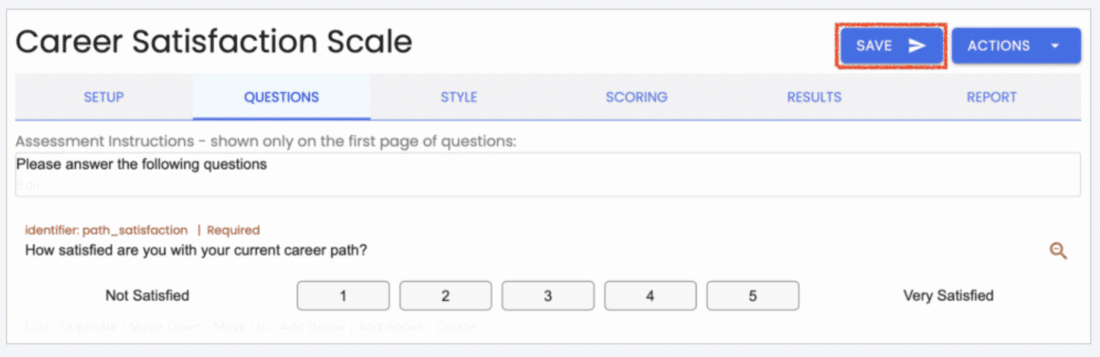
Used frequently in both self-assessments and 360° feedback, rating scales ask respondents to evaluate something on a numeric scale. Picture a manager rating their own coaching ability:
On a scale of 1 to 5, how confident are you in giving regular performance feedback to your team?
When using rating scale questions, think about combining them with benchmarks to deliver meaningful comparisons.
Likert Scale Questions
If you’ve ever clicked “Strongly Agree” or “Disagree” on a form, you’ve seen Likert in action. These questions are powerful because they capture opinions with depth. For example:
I feel supported by my direct supervisor when taking on new challenges.
- Strongly Agree
- Agree
- Neutral
- Disagree
- Strongly Disagree
Likert scales are commonly used in employee engagement surveys, culture audits, and leadership assessments.
As SurveyMonkey explains, using a balanced scale (equal positive and negative options) helps prevent skewed results.
Open-Ended Questions
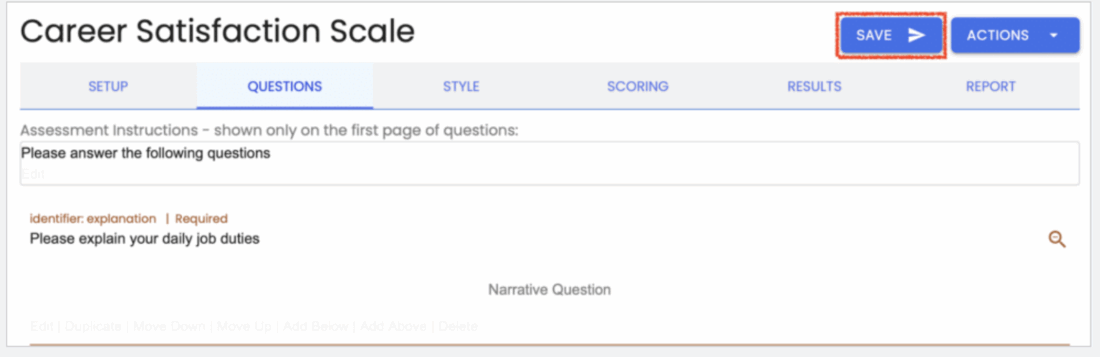
Sometimes, the richest data comes from simply asking, “Why?” Let’s take a look at the below question example:
What challenges have you faced in collaborating with cross-functional teams?
Open-ended questions like this are best for exploring new ideas, capturing qualitative feedback, or uncovering the “why” behind the numbers. However, they do require more effort to analyze, and should be used strategically.
Ranking Questions
When choices matter, ranking questions step in. Let’s say you’re evaluating which employee benefits your team values most:
Rank the following in order of importance:
- Remote work options
- Professional development budget
- Flexible hours
- Health insurance upgrades
Ranking forces respondents to clarify preferences, making it easier for decision-makers to allocate resources.
Drop-down Questions
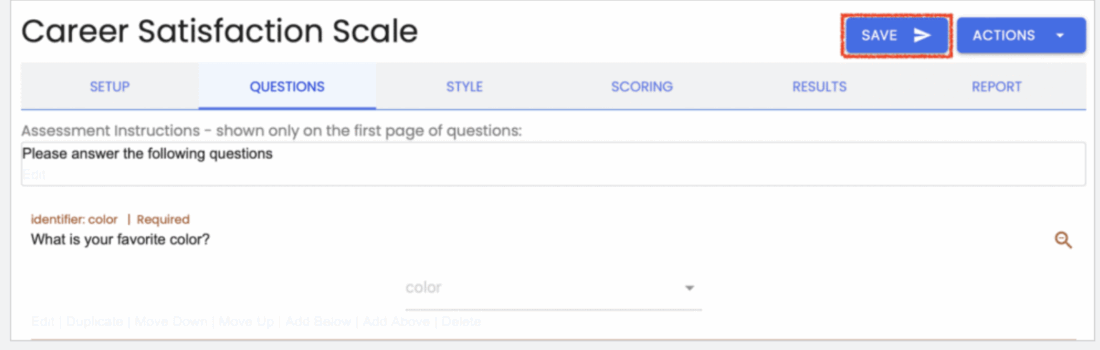
A drop-down format works well when you need to test knowledge or streamline responses without cluttering your form.
For example, a drop-down question is useful for standardized choices like department selection or compliance checklists for employees.
360° Assessment Questions
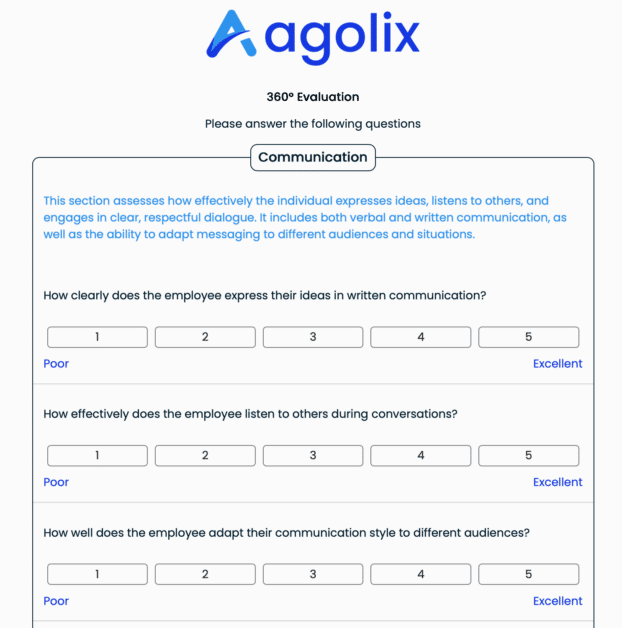
360° assessment questions are all about gathering insights from every angle — manager, peer, direct report, and self. They’re behavior-based and designed to remove bias by collecting input from multiple sources.
Consider this 360° question:
How often does this individual seek feedback to improve their performance?
Unlike traditional reviews, 360°s uncover blind spots and encourage a culture of feedback.
Self Assessment Questions
Self assessment questions empower individuals to reflect on their own progress. They’re perfect for development plans, learning evaluations, and coaching sessions.
A well-phrased self-assessment might ask:
What skill would you most like to improve over the next quarter, and why?
The key is self-awareness, and questions that invite it without judgment. When done right, self assessment questions and their results can drive personal accountability and growth.
How to Choose the Right Assessment Questions
You’ve got your toolbox. Now, how do you pick the right tools (aka questions) for the job?
Start by defining the purpose, or objective, of your assessment. Are you evaluating knowledge, behavior, or perception? Who’s taking it, and what actions will follow?
Then, tailor your question types accordingly. Combine quantitative questions (like rating scales) with qualitative ones (like open-ended responses) to paint a full picture. And always, always test your assessment with a small group before launching it company-wide.
Here’s a quick step-by-step checklist:
- Define the objective: What do you want to measure?
- Know your audience: Are they team members, customers, students?
- Match the question type to the goal: Does the question format support what you’re trying to learn or evaluate?
- Pilot the questions: Test with a small group
- Refine and revise: Improve clarity and remove bias
Examples of Assessment Questions in Real-World Assessments
Let’s say you’re approached by a global nonprofit to revamp their leadership training feedback. Instead of just swapping out their old questions, you restructure the entire approach. By replacing vague satisfaction surveys with targeted Likert scales and open-ended prompts, you can uncover that participants want more hands-on exercises, not just lectures.
In another scenario, imagine a retail client rolling out a 360° assessment to identify rising leaders. With behavior-based questions like, “How consistently does this individual model company values?”, they can pinpoint high-potential employees with renewed accuracy.
These examples show that utilizing the right type of assessment questions will ultimately lead to better decision-making.
5 Tips for Writing Effective Assessment Questions
Effective assessment questions aren’t just about collecting data; they’re about collecting the right data that can lead to meaningful action.
From simple yes/no answers to complex 360° feedback, each question type has its place. What matters is how you use them together to paint a fuller, more honest picture of performance, growth, and opportunity.
As a reminder, here are some tips when crafting your assessment questions:
- Use clear, simple language
- Stay aligned with learning or performance objectives
- Avoid double-barreled questions (e.g., “Is your manager supportive and available?”)
- Mix question types to keep engagement high
- Pilot your assessment before full deployment
Maximize Value with Assessment Questions
At the end of the day, the effectiveness of any assessment hinges on the quality and variety of its questions. Choosing the right assessment question types isn’t just a technical detail; it’s the foundation for gathering insights that actually mean something.
Thoughtful question design leads to more accurate, reliable, and actionable results regardless of your industry, audience, or assessment goal. Don’t be afraid to mix it up! Test new formats, fine-tune your phrasing, and treat your assessments like the dynamic tools they are. The more intentional you are with your question strategy, the more value you’ll get in return.
If you’re ready to revamp your assessments or build a feedback culture that actually works, get started here today with Agolix. We’ve got the tools, experience, and templates to help you turn answers into action.