


Whether you’re a coach, HR leader, or a team lead looking to track development, you’ve probably asked yourself: What is a performance assessment, and how do I build one that actually works?
Let’s face it: traditional performance reviews often feel disconnected, vague, or like another box to tick. But when done right, performance-based assessments can create clarity, reduce bias, and inspire real improvement.
Below, we’ll walk through what a performance assessment really is, how to build one step by step, and share real-life examples you can tailor to your needs.
What Is a Performance Assessment?
A performance assessment is a structured way to evaluate how well someone applies skills, behaviors, or knowledge in real work scenarios.
Think of it as less about checking off tasks and more about understanding how people perform when it matters. This could mean evaluating how someone leads a team meeting, handles a client issue, or completes a technical task.
A performance assessment is not to be confused with:
- Performance evaluations: More top-down and often tied to compensation.
- Annual reviews: Usually infrequent and broader in scope.
Instead, performance assessments emphasize observable behaviors and often feed directly into coaching, development plans, or promotions.
5 Benefits of Using Performance Assessments
When done well, performance assessments offer way more than a score; they provide insight.
Here’s what makes them so valuable:
- Clarity: Everyone knows what’s expected and how performance is measured
- Fairness: Structured scoring reduces unconscious bias
- Growth-oriented: Focus shifts from judgment to development
- Consistency: Regular check-ins beat the once-a-year performance talk
- Data with a human touch: The numbers tell a story, not just a statistic
Ongoing assessments (monthly or quarterly) also outperform annual reviews by making development continuous, not just an end-of-year scramble.
Pro Tip: Use assessments to build a shared language around success. That way, feedback doesn’t feel personal, but directional.
7 Steps Creating a Performance Assessment
Creating a performance assessment doesn’t require a PhD — but the right software can dramatically reduce friction, bias, and follow-through. It just takes a thoughtful approach.
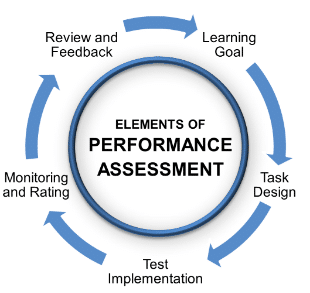
The below diagram from eLearning Industry describes the key elements of a performance-based assessment. The process starts with defining learning goals and advances through the stages of task design, implementation, monitoring, and evaluation, ending with feedback sharing.
Here’s how to get started:
Step 1: Define the Purpose and Outcome
Every effective assessment starts with a clear goal. Are you evaluating team performance? Leadership readiness? Coaching progress?
Ask yourself two things:
- Why are we running this assessment?
- What do we hope to learn?
Your goals might include:
- Measuring leadership skills
- Tracking coaching progress
- Evaluating project performance
- Supporting employee development
Defining the why and the what of your assessment ensures everything that follows stays aligned.
Step 2: Select the Right Competencies or Skills to Measure
You don’t need a 50-question form covering every soft skill under the sun. Pick a few core competencies, such as 4-6, that align with your goals.
These could be grouped into:
- Communication
- Decision-making
- Team leadership
- Problem-solving
- Adaptability
Group similar competencies into categories, which makes your assessment easier to read and complete.
Step 3: Choose Your Question Types
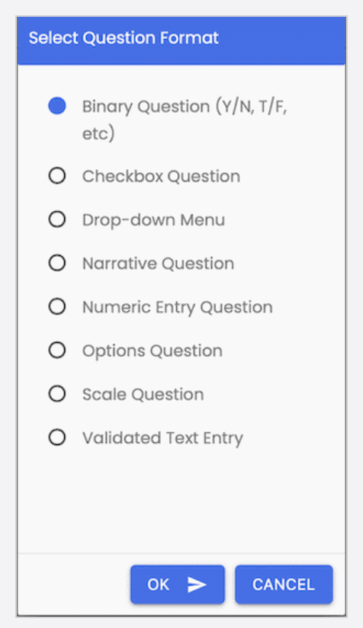
Good questions lead to great insights. Mix up formats to gather rich, usable data:
- Rating scales (e.g., 1-5): Great for measuring consistency or frequency
- Yes/No or Binary: Simple, clear-cut decisions
- Open-ended questions: Allow room for reflection and deeper insights
Agolix lets you choose from a wide variety of question types, including those above.
Here are some best practices for crafting your questions:
- Avoid jargon or technical language
- Don’t combine two ideas in one question (e.g., “communicates clearly and leads meetings well.” Pick one)
Want to add depth? Use scenario-based questions, which are a hallmark of performance-based assessments, to evaluate real-world decision-making. For example, “Imagine you’re leading a project and a team member misses a deadline. How do you respond?”
These reveal how someone might navigate complex situations, which are critical for coaching and development.
Step 4: Structure the Assessment for Flow
Structure matters when building an assessment. A key is to break your assessment into manageable pieces.
Here’s how to keep it smooth:
- Group questions into sections (skills, behaviors, outcomes, reflections).
- Use consistent formatting.
- Limit to 20-25 questions to prevent fatigue.
A clear layout equals a higher completion rate and better quality responses.
Step 5: Set Clear Scoring Criteria
Scoring isn’t just about numbers; it’s about fairness.
Try the below:
- Behavioral anchors (e.g., “Always prepares agenda before meetings” = 5)
- Proficiency levels (Novice → Expert).
- Clear labels like “Excellent,” or “Needs Development”
Defining behavior-based scoring levels increases objectivity and makes results easier to interpret. Platforms like Agolix help ensure scoring logic stays consistent across respondents, roles, and time — especially when using multi-rater or 360° feedback models.
Step 6: Pilot the Assessment Before Launch
Before going live, test your assessment. Here are some best practices:
- Test with a small group of around 5-10 people.
- Ask for feedback on confusing terms or scoring scales.
- Adjust as needed
It’s always better to tweak early than face confusion at scale later on!
Step 7: Automate the Process & Deliver Results
Using a platform like Agolix can help you to:
- Send automated reminders
- Deliver personalized, branded reports
- Analyze data faster and more accurately
Timely feedback keeps people engaged, and leads to better follow-through.
4 Performance Assessment Examples
Let’s look at how assessments are used in real-world situations:
1. Leadership Performance Assessment
- Measures: Decision-making, emotional intelligence, team leadership
- When to use: Leadership development programs, management evaluations, promotion processes
Example: At a growing software company, a leadership coach ran quarterly assessments for directors. They evaluated emotional intelligence, team engagement, and strategic thinking. Over time, they used the data to design personalized development plans, and saw a 20% improvement in team retention within a year.
2. Employee Performance Self-Assessment
- Sample prompt: “Describe a project you led and what you learned”
- Performance self-assessment examples like these help individuals own their growth
Example: A marketing agency introduced performance self-assessment examples to foster reflection. Designers and strategists rated themselves on areas like creativity, time management, and collaboration. Managers used these as starting points for open, two-way conversations.
3. Project-Based Assessment
- Use in: Consulting, skills training, or onboarding
- Project-based assessments give someone a scenario and let you see their approach to solve it
Example: In a consulting firm, new hires were given a real-world client scenario and asked to walk through their approach. This performance-based assessment helped leadership spot problem-solvers early, regardless of background.
4. Team Performance Assessment
- Great for: Group coaching, HR review cycles, and culture audits
- Evaluates collaboration, shared goals, and communication
Example: During a culture reset, an HR team ran a team-wide assessment focused on collaboration and shared accountability. Insights were used in a group offsite to align values and expectations across departments.
Tips for Writing Fair and Effective Performance Assessments
When it comes to designing a performance assessment that actually helps people grow, fairness and clarity should lead the way. One of the most common mistakes we see is the use of vague, subjective language. This refers to phrases like “great attitude” or “team player,” which leave way too much open to interpretation. Instead, aim to describe specific, observable behaviors. For example, “actively contributes ideas during team meetings” paints a much clearer picture than “is engaged.”
Also, keep in mind that attention spans are short, especially in busy workplaces. Assessments that take longer than 15-20 minutes often result in rushed or low-quality answers. Shorter, more focused assessments are not only more respectful of people’s time, but they often yield cleaner, more actionable data.
Timeliness matters too. Imagine filling out a performance assessment and not hearing anything back for weeks; that’s a surefire way to disengage participants. Strive to provide feedback within a week, while everything is still fresh.
Most importantly? Set the tone. Make sure participants know that this isn’t about judgment or evaluation, but reflection, growth, and opportunity. That psychological safety makes all the difference in how open and honest people are in their responses.
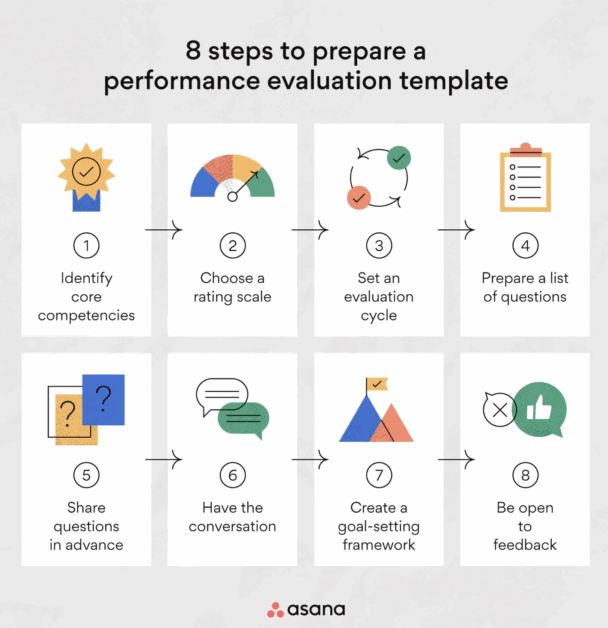
The below graphic from Asana shows the key areas of preparing a performance assessment.
How to Use Your Performance Assessment Data
You’ve done the work, collected the feedback, and now you’re looking at a set of responses. What now?
The magic lies in what happens after the assessment.
Step 1: Turn Insights into Action
If someone scored low on collaboration, use that as a starting point in your next 1:1 conversation. Ask questions, explore context, and set a small, realistic goal that speaks to that feedback.
Step 2: Zoom Out
Don’t just focus on individual scores, but look at the broader patterns. Are several team members struggling with communication? Is one department consistently excelling in cross-functional work? These trends can help inform training initiatives, culture shifts, or leadership strategies.
Step 3: Share the Results
No one wants to feel like they’ve been reduced to a number. Frame the outcomes as a roadmap for development, not a label. Make space for dialogue, protect confidentiality where appropriate, and always give feedback with clarity and compassion.
Remember, performance assessments aren’t just about measurement… They’re about momentum.
Common Mistakes to Avoid When Creating Performance Assessments
Let’s be real: even the best intentions can backfire when performance assessments are rushed, bloated, or poorly communicated. Below are common mistakes when creating your assessments, and how you can best avoid them:
- Trying to measure everything at once: Overloading your assessment with too many competencies leads to diluted feedback and overwhelmed participants. Focus on the most relevant skills or behaviors that support your goals.
- Using inconsistent scoring systems: Mixing rating scales (e.g., 1-5) with vague labels like “excellent” or “adequate” makes your data messy and hard to interpret. Stick to one consistent, clearly defined scoring method.
- Skipping context and communication: If you roll out an assessment without explaining why it’s happening, how the data will be used, and what to expect next, you risk confusion and low engagement. Set the stage before you launch.
- Collecting feedback and doing nothing with it: Few things frustrate participants more than sharing honest input and seeing no follow-up. Even small actions based on the data show that their voice matters.
- Copying generic templates without customization: One-size-fits-all rarely fits anyone well. Tailor your assessments to your organization’s language, goals, and the specific capabilities you want to develop.
One of the biggest missteps? Trying to measure everything in one go. When you overload an assessment with too many competencies, the feedback gets diluted and respondents get overwhelmed. Focus instead on the most relevant skills or behaviors that align with your goals.
Another common pitfall is inconsistent scoring. If one section uses a 5-point scale and another uses vague labels like “excellent” or “adequate,” your data won’t line up, and you risk confusing participants (and yourself)!
Also, never underestimate the power of context. Rolling out an assessment without explaining why it’s happening, how the data will be used, and what participants can expect afterward? That’s a recipe for skepticism and low engagement.
Perhaps the most disheartening mistake, though, is collecting data and then doing absolutely nothing with it. People want to see that their input matters. If you ask for feedback, be ready to act on it, even if in small ways.
Finally, avoid the temptation to just copy and paste a generic template. Great assessments are tailored. They reflect your team’s language, your organization’s goals, and the unique skills you’re trying to grow.
Build Assessments That Support Real Growth
At the end of the day, the best performance assessments don’t just rate, they reveal.
They help people grow, help teams align, and help leaders lead with clarity. Whether you’re coaching a client, leading a team, or revamping your HR practices, a well-designed performance-based assessment can be one of your most powerful tools.
Start simple. Keep it human. Always follow through on what the data tells you.
Are you ready to start using the Agolix platform to build, automate, and deliver customized employee, leadership, and client assessments for insights, growth, and feedback?
Agolix assessments feature branded reports, 360° feedback, progress tracking, and integrations with workflows to enhance understanding of strengths, weaknesses, and development areas. Get started here today!